
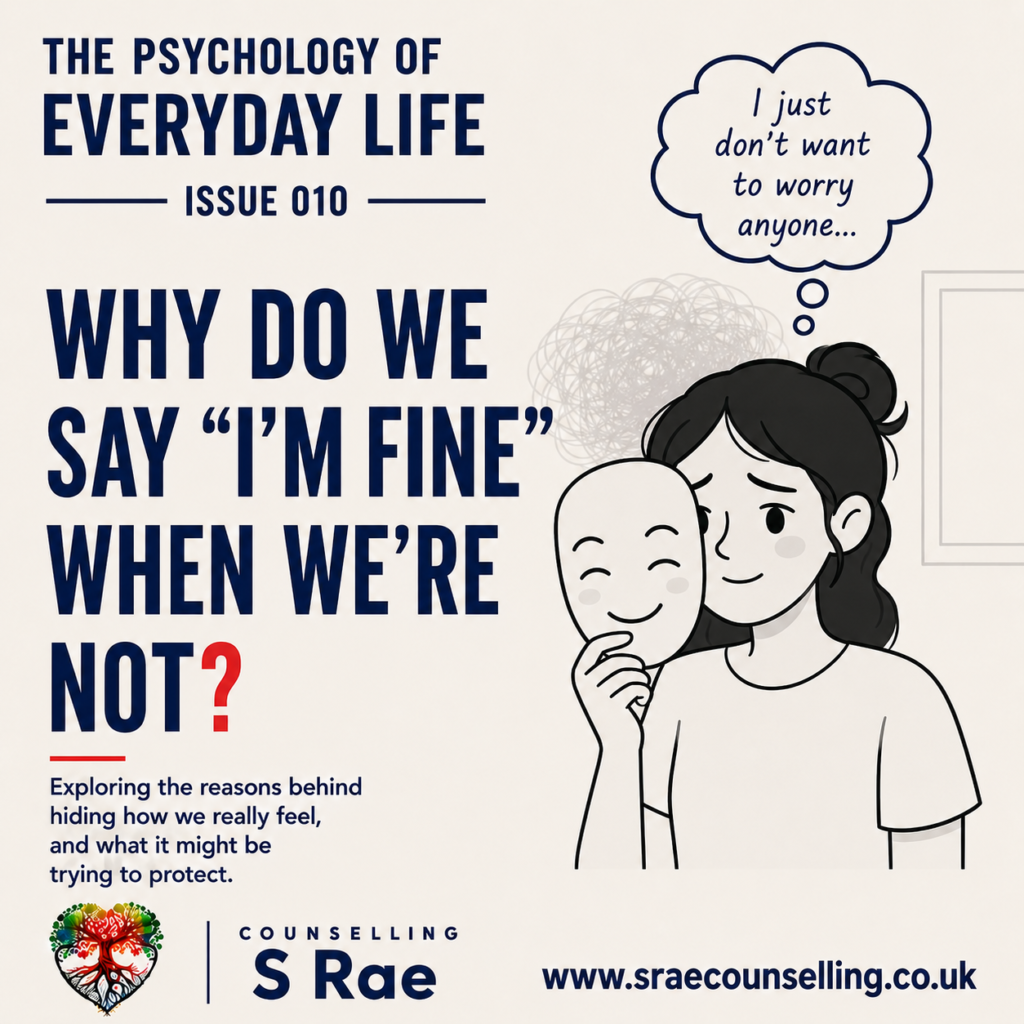
Understanding why we hide our feelings, protect other people and avoid saying what is really happening
Many of us pretend to be fine when we are actually worried, hurt, exhausted or overwhelmed.
Someone asks how we are, and the answer appears almost automatically:
“I’m fine.”
We may smile, change the subject or quickly ask how they are instead. The words can leave our mouth before we have even considered whether they are true.
Sometimes “I’m fine” is simply a polite response. We may not want to discuss our personal feelings with a colleague, acquaintance or someone we have only just met. Protecting our privacy is healthy.
At other times, however, we pretend to be fine because being honest feels too difficult, risky or uncomfortable. We may fear becoming a burden, upsetting someone or discovering that they do not understand.
The words may be hiding far more than we realise.
Why Do We Pretend to Be Fine?
There is rarely one simple reason. We may say “I’m fine” because:
- We do not know how to explain what we feel.
- We are worried about burdening someone.
- We expect our feelings to be dismissed.
- We do not want advice or unwanted questions.
- We are afraid we might become emotional.
- We feel ashamed that we are struggling.
- We believe we should be able to cope alone.
- We do not feel safe enough to be honest.
Saying “I’m fine” can help us end a conversation quickly and regain a sense of control. It may protect us from attention at a moment when we do not feel ready to be seen.
Sometimes “I’m Fine” Protects Our Privacy
Not every “I’m fine” is a sign that something is wrong.
Questions such as “How are you?” are often used as greetings rather than invitations to discuss our emotional lives. We are allowed to decide who receives personal information about us.
We may not have the time, energy or trust required for an honest conversation. We might also know that the setting is not appropriate.
In those situations, “I’m fine” can simply mean:
“I don’t want to discuss this here.”
“I’m not ready to talk about it.”
“I would rather keep this private.”
The difficulty begins when we pretend to be fine with everyone—including the people we trust—and never allow ourselves to receive support.
We May Not Know What We Are Feeling
Sometimes we are not deliberately hiding our feelings. We may genuinely struggle to understand them.
Emotions are rarely simple. We might feel disappointed, anxious, frustrated and exhausted at the same time. Turning that experience into words can be difficult, especially when someone is waiting for an immediate answer.
We may know that something feels wrong without knowing what it is.
“I’m fine” becomes a temporary response while we try to make sense of what is happening inside us.
This can be particularly common when we have spent a long time putting other people’s needs first. We may become skilled at noticing how everyone else feels while losing touch with our own emotional state.
We Do Not Want to Burden Anyone
Many people pretend to be fine because they are worried that honesty will place pressure on someone else.
We may think:
“They already have enough to deal with.”
“My problems are not important enough.”
“I don’t want to bring the mood down.”
“I should be able to manage this myself.”
This response can come from care and consideration. However, it may also reflect a deeper belief that our needs are less important than everyone else’s.
Supportive relationships are not built on one person always being cheerful, calm or self-sufficient. They allow both people to have difficult days, need reassurance and ask for help.
The people who care about us may prefer to know that we are struggling rather than discover later that we felt unable to tell them.
We May Fear Judgement or Rejection
Being honest about our feelings can make us feel vulnerable.
We may worry that someone will think we are weak, dramatic, negative or unable to cope. This fear can become stronger when previous attempts to open up have been dismissed.
Perhaps we have heard:
“You’re overthinking it.”
“Everyone feels like that.”
“Just try to be more positive.”
“Other people have it worse.”
These responses may have been intended to help, but they can make us feel unheard.
When vulnerability has previously led to criticism, embarrassment or disappointment, it makes sense that we might protect ourselves by saying we are fine.
The response is not a personal failure. It may be something we learned to do because honesty did not always feel safe.
We May Be Afraid of Becoming Emotional
Sometimes we say “I’m fine” because we fear that speaking honestly will open an emotional door we cannot easily close.
We may worry that we will cry, become angry or lose control. Keeping the conversation brief helps us contain the emotion until we reach somewhere safer.
This can be useful in the short term. There are moments when we need to complete a responsibility, attend a meeting or get through the day before processing what has happened.
However, constantly containing our emotions can become exhausting.
Feelings that are repeatedly pushed aside may show themselves through:
- Irritability
- Withdrawal
- Physical tension
- Difficulty sleeping
- Emotional numbness
- Tearfulness
- Feeling overwhelmed by small problems
We do not need to express every emotion immediately, but we do need somewhere safe to acknowledge it eventually.
We May Believe Strength Means Coping Alone
Some people have learned that being strong means remaining calm, solving their own problems and never needing support.
They may have been praised for being independent, sensible or “the strong one.” Over time, this identity can make it difficult to admit that they are struggling.
They may think:
“Everyone relies on me.”
“I cannot let anyone see me fall apart.”
“I have to keep going.”
“If I admit this is difficult, I have failed.”
But strength is not the absence of emotion.
Strength can also mean recognising that something has become too much. It can mean asking for help, setting a boundary or admitting that we need rest.
We do not become less capable by acknowledging that we are having a difficult time.
People-Pleasing Can Make Us Pretend to Be Fine
People who feel responsible for keeping others happy may automatically minimise their own emotions.
They may say “I’m fine” because they do not want another person to feel uncomfortable, guilty or responsible.
During conflict, this can sound like:
“It doesn’t matter.”
“Forget about it.”
“Don’t worry about me.”
“Everything’s okay.”
These responses may reduce the immediate tension, but they do not resolve what happened.
When we repeatedly pretend to be fine to protect other people, resentment and emotional distance can slowly build. The other person may not realise that anything needs to change because we have told them everything is okay.
Hiding Our Feelings Can Affect Relationships
When people repeatedly hear “I’m fine,” they may eventually believe us.
They cannot respond to needs they do not know exist.
This can lead to painful misunderstandings:
“You should have told me.”
“I didn’t realise you were struggling.”
“I thought everything was okay.”
We may then feel unseen or unsupported, even though we have worked hard to hide what was happening.
Emotional honesty does not require telling everyone everything. It means allowing appropriate people to understand enough of our experience to support us.
What Can We Say Instead of “I’m Fine”?
Honesty does not have to mean explaining every detail.
There are many responses between pretending everything is okay and sharing our entire emotional experience.
We could say:
- “I’m having a difficult day, but I’m not ready to talk about it yet.”
- “I’ve got quite a lot on my mind.”
- “I’m managing, but things feel heavy.”
- “I’m not really fine, although I appreciate you asking.”
- “I don’t need advice, but I could use someone to listen.”
- “I’m struggling a little and may need some support.”
- “I’m not sure how I feel yet.”
These responses allow us to be truthful while keeping control over how much we share.
Choosing the Right Person Matters
Not everyone is entitled to our vulnerability.
Before opening up, it can help to consider:
- Does this person listen without immediately judging?
- Do they respect privacy and boundaries?
- Can they support me without taking control?
- Do I usually feel safer after speaking with them?
- Is this the right time and place?
Being selective is not the same as shutting everyone out. Emotional safety matters.
The aim is not to stop saying “I’m fine.” It is to notice whether the words are protecting our privacy or preventing genuine connection.
How to Recognise When You Are Pretending to Be Fine
You may be hiding more than you realise when you regularly:
- Reassure everyone while feeling overwhelmed.
- Change the subject when someone asks about you.
- Make jokes whenever a conversation becomes emotional.
- Feel frustrated that nobody notices you are struggling.
- Find it difficult to ask for help.
- Apologise for having emotional needs.
- Wait until you are completely overwhelmed before speaking.
- Feel responsible for keeping everyone else comfortable.
These patterns may have developed because staying quiet once felt safer or more acceptable.
Recognising them creates the opportunity to respond differently.
Practising Emotional Honesty Gradually
You do not need to move from silence to complete openness overnight.
Begin with something small.
Tell a trusted person:
“Today has been harder than I expected.”
Write honestly about how you feel.
Name the emotion privately:
“I feel anxious.”
“I feel hurt.”
“I feel exhausted.”
“I feel disappointed.”
The more accurately we identify our feelings, the easier it becomes to communicate them.
It can also help to explain what kind of support we need. Sometimes we want advice. Sometimes we need practical help. Sometimes we simply want another person to listen without trying to fix anything.
You Are Allowed Not to Be Fine
Nobody feels okay all the time.
Having a difficult day does not mean you are failing. Feeling overwhelmed does not make you weak. Needing reassurance, rest or support does not make you a burden.
You can be capable and struggling.
You can be grateful and unhappy.
You can support other people and still need support yourself.
When we pretend to be fine, we are often trying to protect ourselves or the people around us. That response deserves understanding rather than criticism.
But you also deserve somewhere you do not have to pretend.
Counselling Support
When hiding your feelings, people-pleasing or fear of burdening others makes it difficult to ask for support, counselling can offer a confidential space where you do not have to perform or explain everything perfectly.
Together, we can explore why saying “I’m fine” feels safer and help you communicate your emotions and needs with greater confidence.
Book Your FREE 30-Minute Consultation
Take the first step towards better mental health with a free, no-obligation 30-minute consultation. We’re here to listen and support you.
📞 Call: 07895 843287
📧 Email: sraecounselling@gmail.com
🌐 Visit: sraecounselling.co.uk
Let’s talk—your wellbeing matters. 💙