
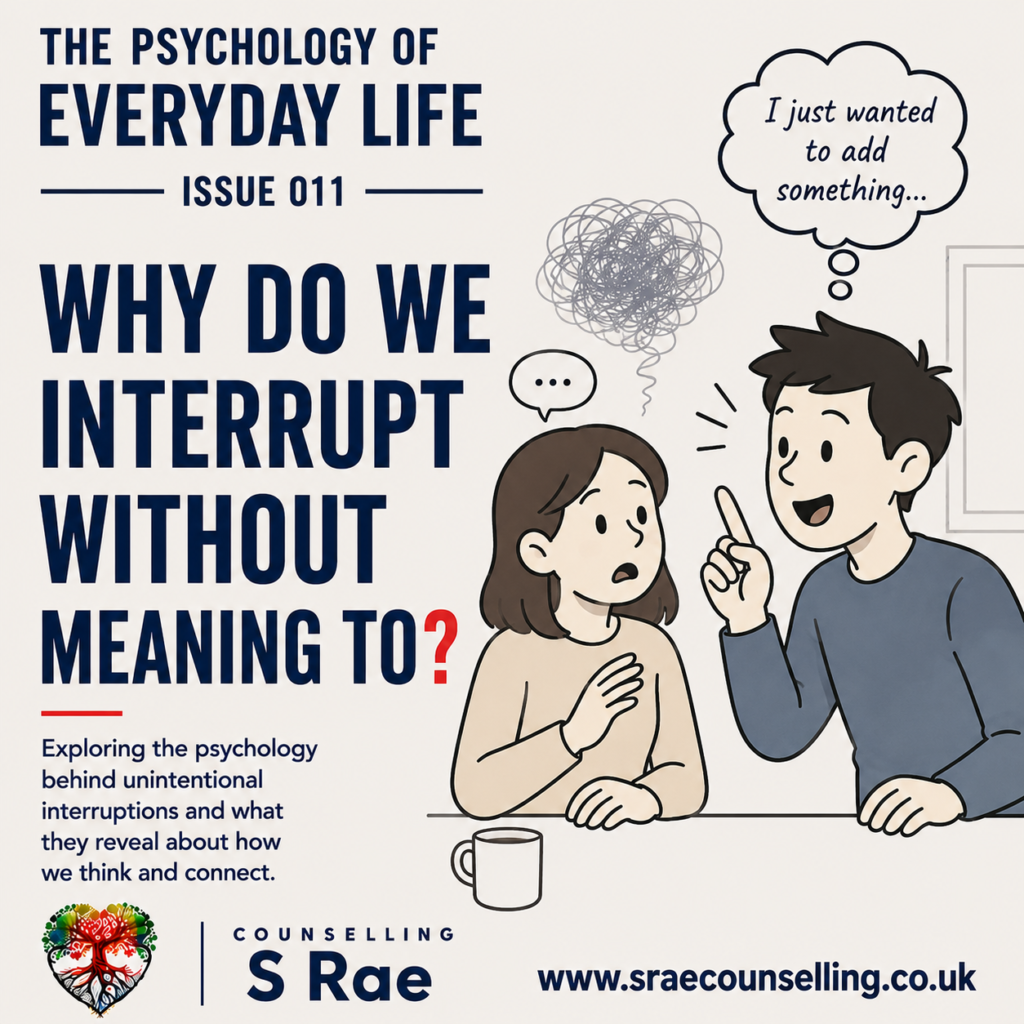
Understanding unintentional interruptions and what they may reveal about attention, excitement and conversational timing
Many of us interrupt without meaning to.
We begin speaking before another person has finished, realise what has happened and quickly say:
“Sorry—I didn’t mean to interrupt.”
Sometimes we are excited by the conversation. Sometimes we worry that we will forget what we wanted to say. At other times, we genuinely believe the other person has reached the end of their sentence.
Interrupting can leave someone feeling unheard, but it does not always mean we are rude, impatient or uninterested. Conversation requires us to listen, understand, remember our thoughts, prepare a response and judge exactly when it is our turn to speak.
That is a great deal for the mind to manage in a very short space of time.
Why Do We Interrupt Without Meaning To?
Conversation may feel natural, but several mental processes are happening at once.
While another person speaks, we are often:
- Listening to their words
- Working out what they mean
- Noticing their tone and expression
- Deciding how we feel about what they said
- Preparing a possible response
- Trying to remember our own point
- Predicting when they will finish
Research into timing during everyday conversation shows that the transition between speakers is often extremely quick, with typical gaps frequently lasting less than 300 milliseconds. Because producing speech usually takes longer than this, listeners often begin planning their response before the current speaker has finished.
Most of the time, this prediction works well. Occasionally, however, we start speaking too early.
The interruption may be a small error in timing rather than a deliberate attempt to take control.
Conversation Leaves Very Little Time to Respond
If we waited until another person had completely finished before beginning to think about our answer, everyday conversation would contain much longer silences.
Instead, our minds predict where a sentence is going and prepare us to respond.
Studies of conversational turn-taking suggest that people generally try to avoid both long gaps and excessive overlap. This pattern appears across different languages, although conversational timing and expectations can vary. You can read more in this research on turn-taking across languages and cultures.
This balancing act can be difficult.
Respond too slowly and the silence may feel uncomfortable. Respond too quickly and we may speak over someone.
Sometimes interruption is simply what happens when we misjudge that very narrow window.
We May Be Worried We Will Forget Our Thought
A useful point can appear in our mind while someone else is still talking.
We may begin mentally repeating:
“Remember to mention that.”
At the same time, we are trying to continue listening.
Holding our idea in mind uses attention. The longer the other person speaks, the more worried we may become that the thought will disappear. Eventually, the pressure to say it can become stronger than our ability to wait.
We jump in—not necessarily because we think our point is more important, but because we are afraid of losing it.
This may happen more frequently when we are tired, distracted, stressed or processing a lot of information. Conversation is cognitively demanding because people must monitor the topic, anticipate the end of a turn and prepare an appropriate response within milliseconds.
Unfortunately, concentrating on remembering our response can also mean that we stop fully listening.
We may hear the words without taking in the meaning because much of our attention is focused on what we intend to say next.
Excitement Can Make Us Speak Too Soon
Sometimes we interrupt because we feel strongly connected to what someone is saying.
Their story reminds us of something we have experienced. We think of a relevant example or feel eager to show that we understand.
We may jump in with:
“That happened to me too!”
“I know exactly what you mean.”
“That reminds me of something.”
From our perspective, we are joining the conversation and showing interest.
From the speaker’s perspective, however, it may feel as though their story has been taken away from them.
Both things can be true:
The intention may be connection, while the impact is interruption.
Recognising the difference allows us to take responsibility without deciding that we are uncaring or deliberately rude.
We May Mistake a Pause for the End
People do not always speak in smooth, complete sentences.
They pause to:
- Search for a word
- Decide what to say next
- Take a breath
- Process an emotion
- Work out how much they want to share
A listener may interpret that pause as an invitation to respond.
Research into face-to-face conversational turn-taking suggests that people rely on more than words when judging whether someone has finished. Gaze, gestures, facial expressions and unfinished movements can all help signal whether the speaker intends to continue.
We may still misread these signals, particularly when someone speaks more slowly than we do or when the topic is emotional.
A pause that sounds finished to one person may simply be a moment of thought for another.
Online Calls Can Make Interruptions More Likely
Video and telephone conversations remove or weaken some of the visual and timing signals we use during face-to-face communication.
Even a small transmission delay can create accidental overlaps. One person thinks the other has stopped speaking, begins their response and then discovers that both are talking at once.
Research into latency during video-mediated conversations found that technical delays can disrupt turn-taking and produce unintended interruptions and silences.
This can make both people appear less patient or attentive than they really are.
When a conversation happens online, it may help to leave a slightly longer pause before responding.
Not Every Overlap Is an Interruption
Two people speaking at the same time does not always mean one person is dismissing the other.
Short responses such as:
“Exactly.”
“Really?”
“I understand.”
“Of course.”
can show that the listener is engaged.
These are sometimes called supportive or cooperative overlaps. They may encourage the speaker rather than stop them.
The important question is:
Did the response support the other person’s turn—or replace it?
A quiet “mm-hmm” may help someone continue. Beginning a long personal story may force them to abandon what they were trying to say.
The difference is not only whether voices overlap. It is whether the original speaker still has room to finish.
Anxiety Can Lead to Interruptions
We often imagine that anxiety makes people quiet, but it can also make someone speak quickly.
A nervous person may feel responsible for keeping the conversation moving. Silence can create uncomfortable thoughts:
“They think I’m boring.”
“I need to say something.”
“This pause feels awkward.”
“They’ll think I’m not interested.”
In trying to prevent the silence, the person may begin speaking before the other person has finished.
The interruption may therefore come from self-consciousness rather than confidence.
The person is not necessarily trying to dominate. They may be trying to prevent rejection or reduce their own discomfort.
Impulsivity Can Affect Conversational Timing
For some people, the gap between having a thought and saying it feels very small.
The words may appear before they have had time to pause and decide whether it is the right moment to speak.
Interrupting conversations can be associated with impulsivity in ADHD. The NHS guide to ADHD in adults includes being very talkative or interrupting conversations among possible hyperactive and impulsive signs. However, one behaviour alone does not mean that someone has ADHD. Assessment considers a broader pattern of symptoms, their history and how they affect different areas of life.
Many people interrupt for reasons completely unrelated to ADHD.
It is helpful to avoid diagnosing ourselves or someone else from a single conversational habit.
Different People Have Different Conversational Styles
In some families and friendship groups, lively overlap is normal.
People may:
- Finish each other’s sentences
- Respond before a story has ended
- Speak at the same time
- Move quickly between topics
- Show enthusiasm through frequent interjections
This style may feel warm and energetic to the people involved.
In other households and cultures, people expect clearer turns and longer pauses. Speaking before someone has completely finished may feel disrespectful.
Neither person may intend to be difficult. They may simply have learned different conversational rules.
This helps explain why one person can leave a conversation thinking:
“That was lively and enjoyable.”
while another thinks:
“Nobody allowed me to finish.”
When Interrupting Makes Someone Feel Unheard
Although interruption may be unintentional, its effect still matters.
Repeatedly being interrupted can make someone feel that:
- Their thoughts are not important
- The listener is waiting to speak rather than listening
- They must rush through their point
- There is no room for their experience
- The conversation always returns to the other person
This can feel especially painful during emotional conversations.
When someone is discussing grief, anxiety, conflict or another difficult experience, they may need extra time to find the right words.
A pause does not always mean they are finished.
Sometimes the most supportive thing we can do is wait a few seconds longer.
Are We Listening—or Preparing Our Reply?
It is possible to appear attentive while mentally rehearsing our own response.
We may be waiting for a particular word or pause that allows us to enter the conversation. When it arrives, we speak immediately, sometimes without fully understanding what the other person was trying to communicate.
A useful reflection is:
“Am I listening to understand—or listening for my opportunity to speak?”
This is not about becoming perfectly silent. It is about noticing where our attention has gone.
When we listen for understanding, our response is more likely to relate to what the person actually needs.
They may not need our similar story, advice or solution. They may simply need us to recognise what they have said.
How to Interrupt Less Without Becoming Afraid to Speak
The aim is not to become silent or monitor every word.
Conversation should still feel natural.
A few small changes can create more space.
Wait for one extra breath
When you think someone has finished, pause for one breath before responding.
This gives them the opportunity to continue if they were only thinking.
Hold one keyword
When you are worried about forgetting your thought, choose one keyword to remind you of it.
This is often easier than mentally rehearsing the entire response while trying to listen.
Notice the urge
Silently acknowledge:
“I want to say something.”
You do not have to follow the urge immediately.
Even a small moment between the thought and the action can help.
Ask whether the person has finished
You can say:
“Were you going to add something?”
“Have you finished that thought?”
This can be especially useful when the person speaks slowly or the subject is emotional.
Allow the other person’s experience to remain central
When their story reminds you of your own, first respond to what they have shared:
“That sounds really difficult.”
“What happened next?”
“How did that affect you?”
You can share your experience later, once they have felt heard.
What to Do When You Realise You Have Interrupted
You do not need a lengthy explanation.
A simple repair is usually enough:
“Sorry—I interrupted you. Please continue.”
“I got ahead of myself. What were you going to say?”
“I want to hear the rest of your point.”
Then stop and return the conversation to them.
The most meaningful apology is not repeatedly saying sorry. It is creating enough space for the person to finish.
If you cannot remember where they were, ask:
“Can you go back to what you were saying before I jumped in?”
This shows that their contribution matters.
What If Someone Regularly Interrupts You?
It is reasonable to ask for more room.
You could say:
“Let me finish this thought, and then I want to hear your point.”
“I’m nearly finished.”
“I lose my train of thought when I’m interrupted.”
“Could you give me a moment to explain this?”
“I know you’re interested, but I need a little more time.”
This does not have to become a confrontation.
Clear communication can help both people understand the conversational rhythm that works best.
Curiosity Is More Helpful Than Shame
If you regularly interrupt without meaning to, harsh self-criticism may not change the habit.
Curiosity is more useful.
Ask yourself:
- Does this happen when I am excited?
- Am I worried I will forget what I want to say?
- Do I feel anxious during silence?
- Am I trying to show that I understand?
- Do I assume a pause means someone has finished?
- Is it harder when I am tired or distracted?
- Does it happen with everyone or only certain people?
The answer can help you understand what the interruption is doing for you.
Perhaps you are processing quickly. Perhaps you are afraid your ideas will disappear. Perhaps you are trying so hard to connect that you accidentally take over.
Understanding the reason does not remove responsibility for the impact. It gives you a better chance of changing the pattern.
You Can Be Enthusiastic and Still Make Space
Interrupting does not automatically make you rude, selfish or uncaring.
You may be interested, excited, anxious or eager to connect.
But good communication is not only about our intention. It is also about whether the other person feels heard.
A brief pause can communicate:
“Your thought matters.”
“You do not need to rush.”
“I am here to understand, not just to reply.”
Learning to wait does not mean your voice is unimportant.
It means recognising that another person’s voice deserves space too.
Counselling Support
When impulsivity, anxiety, communication difficulties or fear of silence affects your conversations and relationships, counselling can offer a calm place to explore what happens in those moments.
Understanding the pattern can help you slow the reaction, listen more comfortably and express yourself without feeling that your thoughts will disappear.
Book Your FREE 30-Minute Consultation
Take the first step towards better mental health with a free, no-obligation 30-minute consultation. We’re here to listen and support you.
📞 Call: 07895 843287
📧 Email: sraecounselling@gmail.com
🌐 Visit: sraecounselling.co.uk
Let’s talk—your wellbeing matters. 💙