
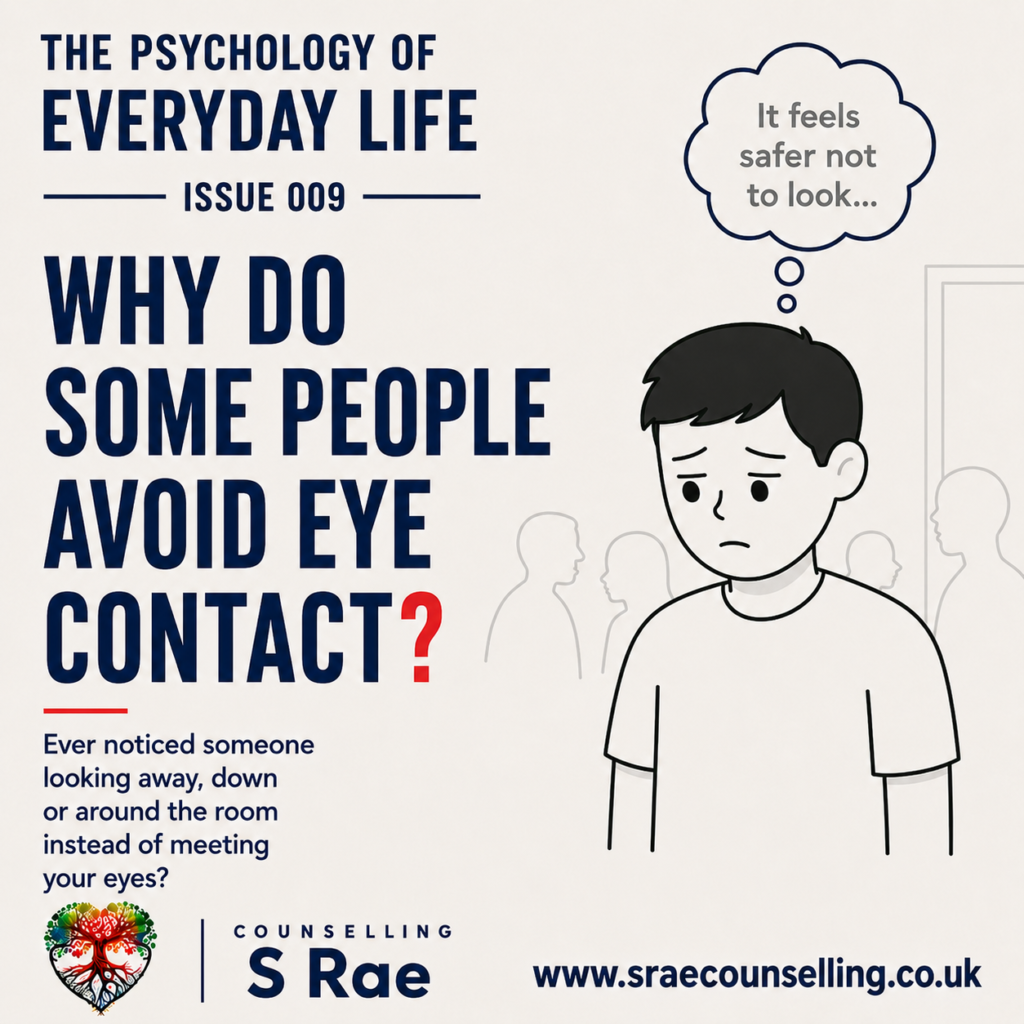
Understanding why looking away may reflect anxiety, concentration, discomfort or a different way of communicating
Some people avoid eye contact during conversations, even when they are listening carefully and genuinely interested in what is being said. They may look down, glance around the room or focus on something nearby rather than meeting another person’s gaze.
This behaviour is often misunderstood. We may assume the person is being dishonest, rude, distracted or unfriendly. In reality, there are many reasons why direct eye contact can feel uncomfortable or make it harder for someone to communicate.
For some people, looking away reduces anxiety. For others, it helps them concentrate, organise their thoughts or manage the intensity of a social interaction. Eye contact is only one part of communication, and its meaning cannot be understood without considering the person and the wider situation.
Why does eye contact feel so powerful?
Eye contact can make an interaction feel more direct and personal. It tells us that another person’s attention is focused on us, which can create connection but may also make us feel exposed.
When someone looks directly at us, we can become more aware of:
- How we appear
- What they might be thinking
- Whether we are saying the right thing
- How our facial expressions are being interpreted
- What we should say next
For someone who already feels self-conscious, this increased awareness can become overwhelming.
Looking away may therefore be a way of reducing the emotional intensity of the interaction rather than rejecting the other person.
Social anxiety can make people avoid eye contact
People experiencing social anxiety may worry intensely about being watched, criticised or negatively evaluated. Avoiding eye contact is recognised as one possible sign of social anxiety, although the behaviour alone does not mean that someone has an anxiety disorder.
Direct eye contact can feel as though the other person is studying every word, expression or mistake. The individual may begin thinking:
“They can see how nervous I am.”
“What if I look strange?”
“They probably think I’m boring.”
“I don’t know how long I’m supposed to look.”
Research using real-world eye tracking has found a relationship between higher levels of social anxiety and more avoidant gaze behaviour during social situations. Looking away may temporarily reduce the feeling of being evaluated.
The difficulty is that this relief can sometimes reinforce the fear. If the person always looks away, they may never discover that brief, natural eye contact can be manageable and that the other person may not be judging them at all.
Eye contact can make it harder to think
We do not only look away because we feel anxious.
People naturally avert their gaze when answering a difficult question, remembering information or trying to organise their thoughts. Looking directly at another person’s face provides a large amount of social and visual information for the brain to process.
Temporarily looking away can reduce that mental demand and make it easier to concentrate. Studies have described gaze aversion as a strategy people use to manage cognitive load while thinking.
You may have noticed yourself doing this when someone asks:
“What did you do last weekend?”
“How would you solve this problem?”
“What do you really think about what happened?”
You look upwards, down at the table or across the room while forming your answer.
This does not necessarily mean you are disengaged. You may actually be giving the question more attention.
Some neurodivergent people experience eye contact differently
Some autistic and otherwise neurodivergent people may find direct eye contact intense, distracting or physically uncomfortable.
For one person, looking into someone’s eyes may make it harder to listen to their words. For another, it may create anxiety or an overwhelming awareness of being watched. Others may simply process facial and social information differently.
Research suggests there is no single explanation for reduced eye contact among autistic people. Experiences and underlying mechanisms vary, and first-hand accounts frequently describe eye contact as stressful, distracting or something that requires conscious effort.
Insisting that someone continually maintain eye contact can therefore make communication more difficult rather than improving it.
A person may listen more effectively while looking at your shoulder, their hands or another point in the room.
Past experiences can influence eye contact
People may also avoid eye contact because of what direct attention has represented in the past.
Someone who has regularly been criticised, shouted at, embarrassed or closely monitored may associate direct eye contact with conflict or judgement.
Looking down or away may have developed as a way to feel safer, avoid attracting attention or reduce the possibility of confrontation.
These reactions can become automatic. The person may not consciously think, “Eye contact is dangerous.” Their body may simply respond with discomfort when someone looks directly at them.
This does not mean the person is weak. It may mean that looking away once helped them cope with difficult situations.
Low confidence can create self-consciousness
When we feel uncertain about ourselves, eye contact may seem to place us under a spotlight.
Someone with low confidence may worry that the other person will notice:
- Their nervousness
- Their appearance
- A change in their voice
- Their uncertainty
- That they do not know what to say
Looking away can briefly reduce this sense of exposure.
The person may still want connection, but fear that being fully seen will lead to criticism or rejection.
This can create a difficult contradiction: they want to engage, yet the behaviours that help them feel safe may be interpreted as disinterest.
Cultural expectations around eye contact differ
Eye contact does not have the same meaning in every culture or social setting.
In some cultures, sustained eye contact may communicate confidence and attentiveness. In others, it may be considered overly direct, disrespectful or confrontational—particularly when speaking with an older person or someone in authority.
Research has identified cultural differences in how direct and averted gazes are perceived and used during social communication.
This means we should be careful about applying one set of social expectations to everyone.
What appears avoidant from one perspective may be respectful behaviour from another.
Does avoiding eye contact mean someone is lying?
A lack of eye contact is sometimes treated as evidence that a person is dishonest.
This is an unreliable assumption.
Someone who is telling the truth may look away because they are anxious, embarrassed, concentrating or uncomfortable with attention. A confident person may maintain eye contact while saying something untrue.
Eye contact alone cannot tell us whether someone is being honest.
Interpreting it as proof of dishonesty can unfairly judge people who communicate differently or who find social situations difficult.
Does it mean they are not listening?
Not necessarily.
Some people listen by watching the speaker closely. Others understand and remember more when they are not trying to manage constant eye contact at the same time.
A person may be listening carefully while:
- Looking at their hands
- Focusing on a nearby object
- Walking beside you
- Drawing or fidgeting
- Looking up only occasionally
Communication should be judged through the whole interaction, not one behaviour.
Are they responding to what you say? Do their answers show understanding? Are they remembering details? These signs may tell you more than where they are looking.
Finding a comfortable balance
Healthy eye contact does not usually involve staring continuously.
Most conversations naturally include moments of looking towards someone and looking away. This creates space to think while maintaining a sense of connection.
Someone trying to feel more comfortable with eye contact might begin with small steps:
Use brief eye contact
Look towards the other person for a moment, then allow your gaze to move naturally. There is no requirement to maintain continuous contact.
Look near the eyes
Looking at the bridge of the nose, eyebrows or upper face can feel less intense while still appearing engaged.
Practise in safer situations
It may be easier to practise with someone trusted rather than in a busy room or unfamiliar social setting.
Focus on the conversation
Try to listen to what is being said rather than constantly checking whether your eye contact looks correct.
Allow yourself to look away while thinking
You do not need to maintain eye contact while processing every question. Looking away can be a natural part of conversation.
The aim should not be to perform eye contact perfectly. It should be to communicate in a way that feels manageable and genuine.
How can we respond when someone avoids eye contact?
Rather than immediately deciding that the person is uninterested, try allowing for other explanations.
You can help by:
- Maintaining a relaxed tone
- Avoiding demands such as “Look at me when I’m speaking”
- Giving them time to respond
- Sitting beside them rather than directly opposite
- Paying attention to their words and overall engagement
- Asking what makes communication easier for them
Some conversations feel less intense when people are walking, driving or completing an activity together because there is less pressure to maintain direct gaze.
Respecting a person’s communication style can make them feel safer and may help the conversation flow more naturally.
Avoiding eye contact does not define someone
There is no single explanation for why people avoid eye contact.
It may reflect anxiety, shyness, concentration, neurodivergence, cultural expectations, previous experiences or simply personal preference.
It is also possible for the same person to use eye contact differently depending on the situation. They may feel comfortable with family but struggle around strangers, authority figures or in emotionally difficult conversations.
Rather than asking, “What is wrong with them?” a more helpful question might be:
“What could help this person feel more comfortable communicating?”
Eye contact can support connection, but it is not the only way to show attention, honesty, warmth or respect.
Counselling support
When anxiety, low confidence or fear of judgement makes social interaction difficult, counselling can offer a safe place to understand what is happening.
Exploring why you avoid eye contact may help you recognise the thoughts and experiences behind the discomfort, reduce self-consciousness and develop ways of communicating that feel more natural.
To arrange a free 30-minute consultation with S Rae Counselling:
📞 07895 843287
📧 sraecounselling@gmail.com
🌐 www.sraecounselling.co.uk