
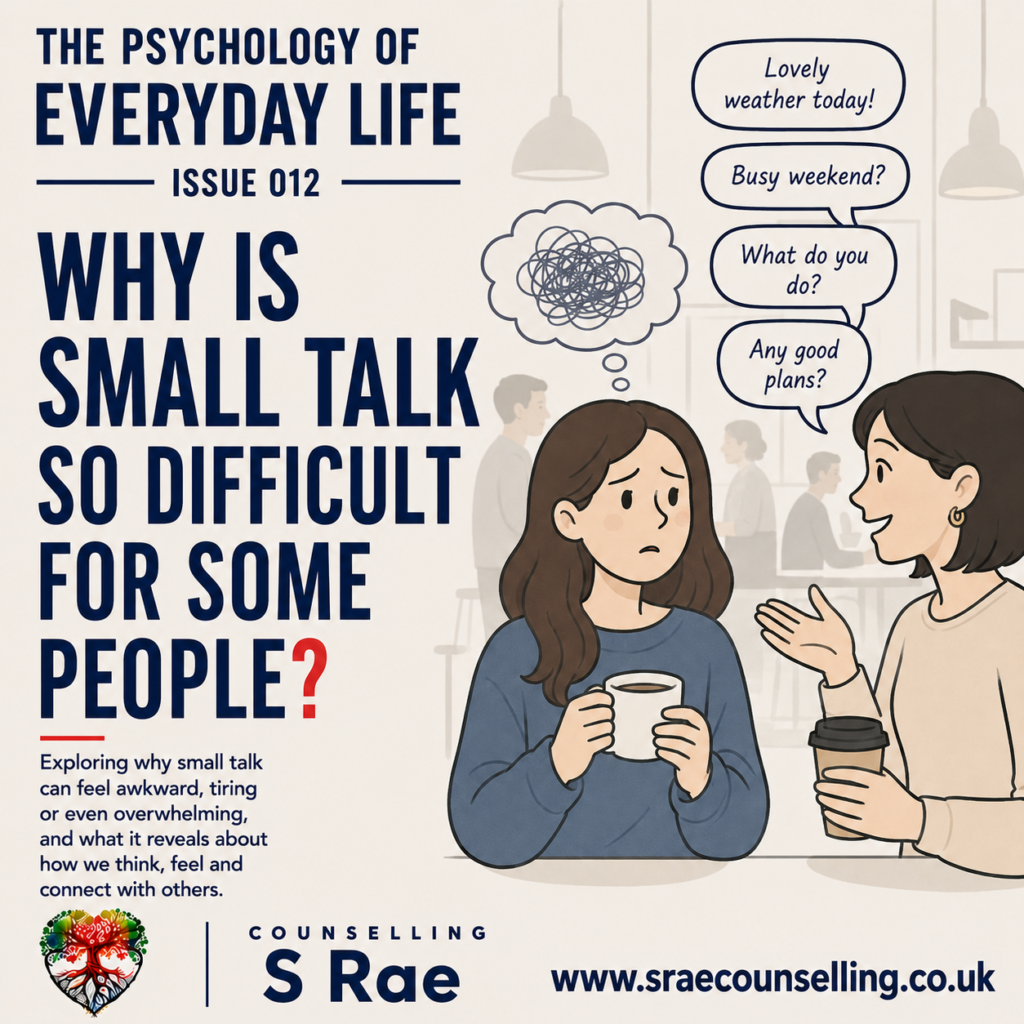
Understanding small talk anxiety, social pressure and why casual conversation can feel surprisingly exhausting
Small talk anxiety can make an ordinary conversation feel like a test.
Someone asks what we did at the weekend, comments on the weather or asks what we do for work. The question is simple, yet our mind suddenly feels crowded:
“What am I supposed to say?”
“Am I giving too much information?”
“Do I sound boring?”
“How do I keep this conversation going?”
Small talk may appear effortless from the outside, but it asks us to listen, respond, read social signals, think of suitable questions and judge how much to share—all while trying to appear relaxed.
For some people, this happens naturally. For others, it feels awkward, tiring or overwhelming.
Finding small talk difficult does not mean someone is unfriendly, uninterested or incapable of forming meaningful relationships. They may simply feel more comfortable when a conversation has a clear purpose, greater depth or fewer unspoken social expectations.
What Is Small Talk?
Small talk is light conversation about familiar, relatively safe topics.
It often includes:
- The weather
- Work
- Weekend plans
- Travel
- Local events
- Television
- Holidays
- How busy the day has been
The information itself may not seem especially important. However, small talk often serves a social purpose.
It can help people:
- Signal friendliness
- Reduce tension
- Find areas of shared interest
- Decide whether a longer conversation feels comfortable
- Create connection before discussing something more personal
Research has described small talk as a common feature of social interaction that can influence how people form first impressions of one another.
The difficulty is that the purpose is rarely explained. We are not always exchanging information because the weather itself matters. We may be showing that we are open to connection.
For someone who prefers direct and meaningful communication, this unspoken purpose can feel confusing.
Why Does Small Talk Anxiety Develop?
Small talk involves uncertainty.
We do not always know:
- What the other person wants from the interaction
- How long the conversation should last
- Which subjects are appropriate
- Whether they are genuinely interested
- When it is our turn to speak
- How much personal information to share
- How to finish the conversation politely
There is no written script, yet we may feel that everyone else understands the rules.
This can create small talk anxiety, particularly when someone is already worried about being judged, misunderstood or appearing awkward.
Instead of simply participating in the conversation, they may begin monitoring themselves:
“Was that answer too short?”
“Should I ask them something back?”
“Have I made this awkward?”
“Am I making enough eye contact?”
The more closely we monitor ourselves, the harder it becomes to respond naturally.
Social Anxiety Can Make Small Talk Feel Like a Performance
Social anxiety is more than occasional shyness. It can involve persistent worry before, during and after social situations, often connected to fears of embarrassment, criticism or rejection. The NHS notes that people with social anxiety may worry about meeting strangers, starting conversations, speaking on the phone and taking part in group situations.
For someone experiencing social anxiety, a casual conversation may feel far from casual.
Their attention may shift away from the other person and towards their own performance:
“Do I look nervous?”
“Was that a strange answer?”
“What if my mind goes blank?”
“What if they want to leave?”
The conversation may then become evidence-gathering. Every pause, facial expression or short answer is examined for signs that something has gone wrong.
Even after the interaction ends, the person may replay it and criticise what they said.
The difficulty is not a lack of interest in other people. It may be an intense fear of getting the interaction wrong.
The Pressure to Find the “Right” Answer
Small-talk questions are often open enough to create uncertainty.
“How are you?”
“What have you been up to?”
“Any plans for the weekend?”
A person may immediately begin editing their response.
The honest answer might feel too personal. A short answer might seem unfriendly. A detailed answer might feel like oversharing.
They may try to calculate the perfect response while the other person waits.
This can make even a simple question feel mentally demanding.
For example:
Question: “How was your weekend?”
The mind may respond:
“Do they really want to know?”
“Should I mention that I stayed home?”
“Will that sound boring?”
“Should I ask about their weekend first?”
The conversation has moved from a simple exchange into a rapid series of decisions.
Some People Prefer Purposeful or Deeper Conversation
Not everyone enjoys conversation for the same reasons.
Some people feel energised by quick, light exchanges with many different people. Others prefer conversations based on shared interests, emotional honesty or a clear purpose.
They may find it easier to discuss:
- A subject they care deeply about
- A practical problem
- A meaningful personal experience
- An idea or current project
- Something they genuinely want to understand
This does not necessarily mean they dislike people.
They may simply struggle with conversation that feels repetitive or unclear. They might find it easier to connect through substance rather than social ritual.
Research examining everyday conversation has suggested that more substantive conversations can be associated with wellbeing, although this does not mean small talk is inherently negative or that everyone needs the same balance.
Small talk may be the doorway to connection, but some people find standing in that doorway harder than entering the room.
Small Talk Can Be Difficult for Some Autistic People
Some autistic people describe casual conversation as confusing, tiring or stressful.
The difficulty may involve:
- Understanding unspoken social expectations
- Knowing when to begin or end a conversation
- Working out whether a question is literal or polite
- Moving quickly between unrelated topics
- Managing eye contact and speech at the same time
- Processing voices, background noise and facial expressions
- Feeling pressure to appear socially typical
Research involving autistic adults has described the use of learned conversational rules and social camouflaging strategies to get through small talk with less visible difficulty. These strategies can make interaction appear effortless while requiring considerable concentration.
More recent research also emphasises that autistic communication should not simply be viewed as a collection of personal deficits. Misunderstandings can be mutual, arising when people with different communication styles interpret one another through different expectations.
An autistic person may communicate comfortably and naturally with someone who shares their style, while finding conventional small talk much more effortful.
Avoiding or disliking small talk alone does not mean someone is autistic. There are many possible reasons, and no single behaviour should be used to diagnose a person.
Sensory Overload Can Make Conversation Harder
Small talk often happens in busy places:
- Cafés
- Offices
- Waiting rooms
- Shops
- Parties
- Networking events
- Public transport
The person may be trying to follow a conversation while also processing music, nearby voices, movement, lighting and interruptions.
When the environment already feels overwhelming, generating a relaxed conversational response becomes harder.
Someone may appear distracted or quiet because their attention is being pulled in several directions. They may need more time to understand what was said and decide how to respond.
Research based on autistic people’s first-hand experiences has described how speech can become difficult to follow in noisy or sensory-demanding environments.
Moving to a quieter space may help more than encouraging the person to “try harder” socially.
We May Fear Running Out of Things to Say
One of the most common worries about small talk is that the conversation will stop.
We may feel responsible for preventing every silence.
As one topic begins to fade, our mind searches urgently for another:
“Ask about work.”
“Mention the weather.”
“Say something about the coffee.”
“Don’t let it become awkward.”
This pressure can make listening difficult. Instead of hearing what the other person says, we are preparing the next subject.
A quiet pause then feels like proof that we have failed.
But pauses are a normal part of conversation. They give both people time to think. A few seconds of silence do not automatically mean the interaction has gone badly.
Past Experiences Can Affect Small Talk Anxiety
Previous social experiences can shape how safe conversation feels.
Someone who has been mocked, excluded, criticised or told they are awkward may become highly alert during future interactions.
They may learn to expect embarrassment.
Their thoughts might include:
“People usually misunderstand me.”
“I always say the wrong thing.”
“They will lose interest.”
“I need to be careful.”
The person may rehearse conversations, avoid unfamiliar people or keep answers very short to reduce the possibility of judgement.
These behaviours are not necessarily signs that they do not want connection. They may be protective responses developed after connection felt unsafe.
Small Talk Can Feel Emotionally Inauthentic
Some people struggle because the expected response does not match what they really feel.
Someone asks:
“How are you?”
The socially expected answer may be:
“Fine, thanks. You?”
But perhaps the person is grieving, anxious, exhausted or overwhelmed.
They may feel uncomfortable offering an automatic positive response, yet recognise that the setting is not suitable for a full explanation.
This creates tension between honesty and social convention.
A middle-ground response can help:
“I’ve had a busy week, but I’m getting there.”
“I’m a little tired today, although it’s nice to see you.”
“There’s a lot going on, but thank you for asking.”
This allows some authenticity without requiring the person to share more than feels appropriate.
Introversion and Small Talk Are Not the Same Thing
Introversion is sometimes used as a complete explanation for small-talk difficulty, but it is not quite that simple.
An introverted person may be socially confident and skilled at casual conversation but need time alone afterwards. An extroverted person may enjoy company while still feeling anxious about being judged.
Introversion, shyness, social anxiety and autism are different experiences, although they can overlap.
It is more helpful to ask what specifically makes the conversation difficult:
- Is it fear of judgement?
- Is it sensory overload?
- Is it uncertainty about the rules?
- Does the conversation feel unrewarding?
- Is the person tired or emotionally overwhelmed?
- Are they afraid they will have nothing to say?
Understanding the reason is more useful than attaching a quick label.
Why Small Talk Still Has Value
Although small talk can feel superficial, it can play an important role.
A brief conversation with a neighbour, colleague or shop worker can create a sense of familiarity and belonging. These lighter connections are sometimes described as “weak ties”—relationships outside our closest circle that can still contribute to feeling part of a wider community.
Small talk can also act as a gradual trust-building process.
Before someone shares something personal, they may need to know:
“Will this person listen?”
“Do I feel comfortable around them?”
“Is this interaction safe?”
The purpose of small talk is not always the topic itself. It may be the first step towards something more meaningful.
However, recognising its purpose does not mean everyone must find it easy.
How to Make Small Talk Feel More Manageable
The aim is not to become endlessly sociable or force yourself into uncomfortable situations.
A few simple strategies may reduce the pressure.
Keep a Few Reliable Questions Ready
You might use:
“How has your week been?”
“Have you been busy today?”
“How do you know the host?”
“Have you been here before?”
“What are you working on at the moment?”
Prepared questions are not dishonest. They reduce the mental work required to begin.
Use What Is Already Around You
The environment can provide a natural subject:
“This place is busier than I expected.”
“That looks good—have you tried it before?”
“The weather has changed again.”
You do not need to produce an original or impressive topic.
Ask One Follow-Up Question
Listen for one detail in the person’s answer.
If they say they visited family, you could ask:
“Do they live nearby?”
If they mention a busy week, ask:
“Has work been particularly hectic?”
Small talk becomes easier when you respond to what is already present rather than constantly inventing new topics.
Share a Small Amount About Yourself
Conversation becomes tiring when one person feels responsible for asking every question.
Offer a brief answer of your own:
“I haven’t been there, but I’ve heard it’s lovely.”
“My weekend was quiet, which was exactly what I needed.”
This creates something the other person can respond to.
Allow the Conversation to End
Not every interaction needs to become a long conversation.
You can finish warmly:
“It was lovely speaking to you.”
“I’ll let you get back to your day.”
“I’m going to grab a drink, but it was nice to meet you.”
Knowing you can leave may make starting feel less threatening.
What Can Help Someone Who Finds Small Talk Difficult?
When someone appears quiet or uncomfortable, try not to place the full responsibility for the conversation on them.
You can help by:
- Asking one question at a time
- Allowing extra time for an answer
- Avoiding rapid topic changes
- Accepting shorter responses without interpreting them as rejection
- Moving somewhere quieter when possible
- Sharing information rather than conducting an interview
- Choosing a shared activity that reduces constant eye contact
- Asking about interests they genuinely enjoy
A person may communicate much more easily when they feel accepted rather than assessed.
Small Talk Difficulty Does Not Mean Social Failure
Some people are naturally skilled at walking into a room and beginning light conversations.
Others need time, familiarity or a more meaningful subject before they feel comfortable.
Neither approach determines how caring, intelligent or socially valuable someone is.
A person can find small talk exhausting and still be a thoughtful friend.
They can struggle to begin conversations and still listen deeply.
They can appear quiet in groups and become expressive when they feel safe.
The difficulty may not be a lack of social ability. It may be the effort required to communicate under a particular set of expectations.
When Might Support Help?
Occasional discomfort with small talk is common.
However, support may be helpful when fear of conversation:
- Causes significant distress
- Leads to regular avoidance
- Affects work, education or relationships
- Creates intense worry before and after social situations
- Prevents someone from doing things that matter to them
The NHS advises seeking support when social anxiety is having a significant impact on everyday life. Treatments and support are available, and people do not have to wait until the difficulty becomes overwhelming.
Counselling can help someone understand the thoughts, experiences and expectations behind their small talk anxiety without treating their personality as a problem that needs to be corrected.
Counselling Support
When social situations leave you feeling judged, overwhelmed or disconnected, counselling can offer a quiet space to explore what happens beneath the discomfort.
Together, we can look at the fears and experiences influencing social interaction, develop greater self-understanding and find ways of communicating that feel more natural.
Book Your FREE 30-Minute Consultation
Take the first step towards better mental health with a free, no-obligation 30-minute consultation. We’re here to listen and support you.
📞 Call: 07895 843287
📧 Email: sraecounselling@gmail.com
🌐 Visit: sraecounselling.co.uk
Let’s talk—your wellbeing matters. 💙