
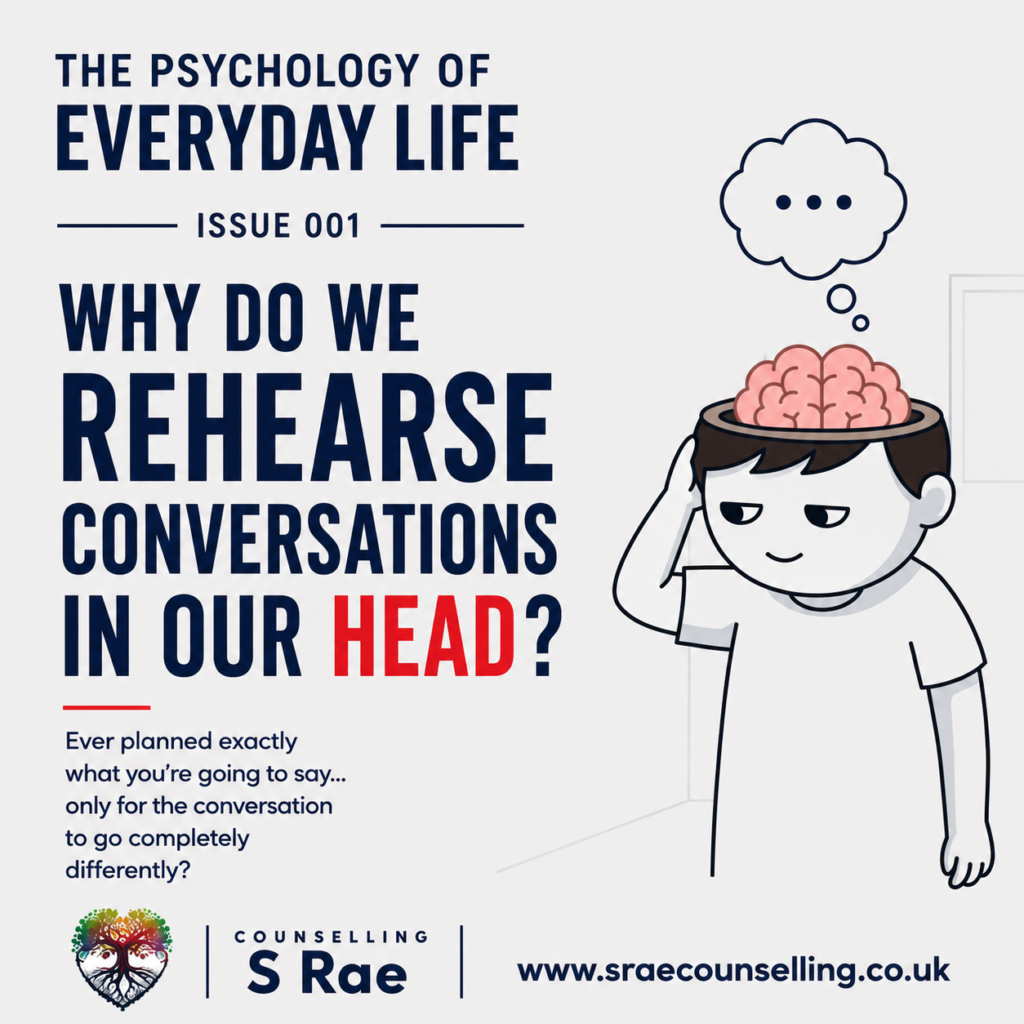
Issue 001
Why Do We Rehearse Conversations In Our Head?
Ever planned exactly what you’re going to say… only for the conversation to go completely differently?
The Situation
Have you ever found yourself replaying tomorrow’s conversation before it’s even happened?
- Asking your manager for time off
- Bringing up something that’s been bothering you
- Preparing for an awkward family chat
Your mind starts writing the script:
“What if they say this?”
“I’ll answer with that…”
“No… maybe I’ll say it differently.”
By the time the conversation actually happens, you’ve already lived it dozens of times in your head.
If that sounds familiar, you’re certainly not alone.
The Psychology
Mentally rehearsing conversations is often your brain’s way of preparing for uncertainty.
Our brains like predictability. When we don’t know how someone will respond, we imagine different outcomes to feel more prepared.
✅ A little rehearsal can help:
- Organise your thoughts
- Build confidence
- Clarify what you want to say
⚠️ But sometimes it goes too far:
Instead of helping, your mind starts looping the same conversation again and again. You search for the perfect response to situations that may never even happen.
At that point, it’s no longer about the conversation.
It’s about trying to reduce uncertainty.
A Different Perspective
What if rehearsing conversations isn’t overthinking?
What if it’s your mind trying to protect you?
We naturally want to avoid:
- Embarrassment
- Conflict
- Rejection
So our brains try to prepare us.
But here’s the reality:
Conversations aren’t scripts. They’re shared experiences.
The other person hasn’t rehearsed their lines. They might respond with more understanding—or less concern—than you’ve imagined.
Maybe the goal isn’t to stop preparing.
Maybe it’s learning when preparation turns into trying to control the uncontrollable.
Something to Think About
Next time you catch yourself replaying a conversation, pause and ask:
“Am I preparing… or am I trying to control something I can’t predict?”
Sometimes confidence doesn’t come from having the perfect words.
It comes from trusting yourself to respond in the moment.
Understanding ourselves is the first step towards changing ourselves.
Continue the Conversation
Have you ever rehearsed a conversation that turned out completely differently in real life?
The Psychology of Everyday Life
A weekly editorial series from S Rae Counselling exploring the everyday behaviours, thoughts and emotions that make us human.
Next Issue
Issue 002 — Why Do Some People Hate Phone Calls?