
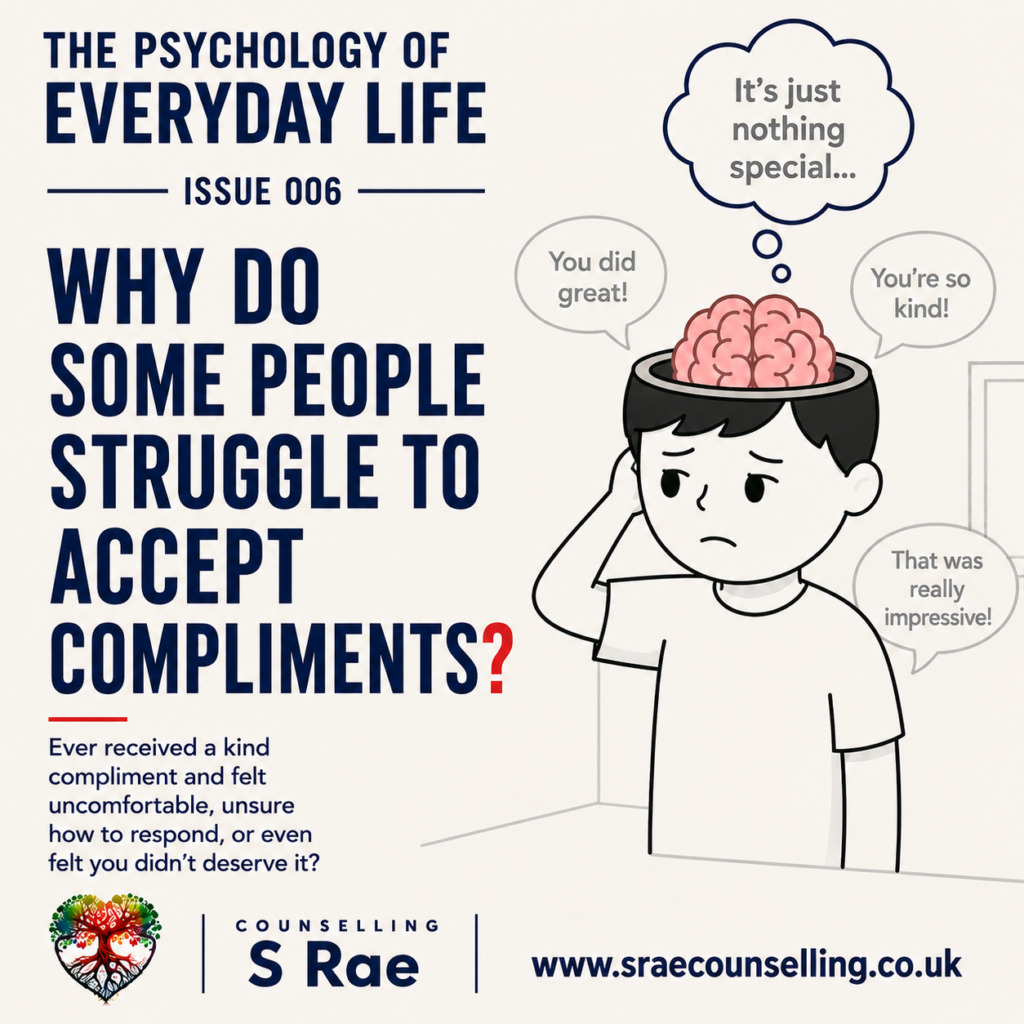
Understanding why kind words can sometimes make us feel uncomfortable
Some people find it surprisingly difficult to accept compliments. A friend says we look good, a colleague praises our work or someone recognises something kind we have done—and instead of simply saying thank you, we immediately dismiss it.
“It was nothing.”
“Anyone could have done it.”
“I just got lucky.”
“You’re only saying that to be nice.”
Although compliments are usually intended to make us feel appreciated, they can sometimes create embarrassment, discomfort or uncertainty. We may not know how to respond, worry that accepting the compliment will make us appear arrogant or struggle to believe that the positive words are true.
Understanding why this happens can help us receive appreciation with less discomfort and greater self-compassion.
Why can it be difficult to accept compliments?
A compliment draws attention towards us.
For someone who feels uncomfortable being noticed, even positive attention can feel exposing. We may suddenly become aware of how we are standing, what our face is doing and what we are expected to say next.
Our mind may begin asking:
“Do they really mean it?”
“What am I supposed to say?”
“Will I sound full of myself if I agree?”
“What if they expect something from me now?”
Instead of enjoying the kind words, we may focus on escaping the discomfort as quickly as possible. Dismissing the compliment can become a way of moving the attention away from us.
Compliments may conflict with how we see ourselves
One reason people struggle to accept compliments is that the positive message does not match their existing self-image.
If someone believes they are not particularly talented, attractive, capable or worthy, a compliment can feel difficult to process. The other person’s words conflict with what they already believe about themselves.
For example, someone who regularly thinks, “I’m not good enough,” may find it hard to believe a colleague who says, “You did an excellent job.”
Rather than reconsidering the negative belief, the mind may reject the compliment:
“They’re just being polite.”
“They don’t know how much help I needed.”
“It wasn’t really that good.”
This does not necessarily mean the person wants to be negative. Their response may simply reflect a deeply established way of seeing themselves.
We may worry about appearing arrogant
Many people have been taught to be modest and avoid drawing attention to their achievements.
Modesty can be a positive quality, but it can sometimes become the belief that accepting praise is boastful or self-important.
A person may feel that saying “thank you” means agreeing that they are better than other people. In reality, accepting a compliment does not require superiority or arrogance.
It simply means acknowledging that someone has noticed something they appreciate.
There is a difference between saying:
“I am better than everyone else.”
and:
“Thank you. I appreciate you saying that.”
Learning to accept compliments does not mean developing an inflated opinion of yourself. It means allowing positive feedback to exist without immediately arguing against it.
Past criticism can make praise difficult to trust
Our response to compliments can also be shaped by earlier experiences.
Someone who was frequently criticised, compared with others or made to feel that their efforts were never enough may struggle to trust praise later in life.
They may wonder whether the compliment is sincere or whether criticism will follow.
A kind comment might create thoughts such as:
“What do they really want?”
“Are they making fun of me?”
“They’ll change their mind when they know me better.”
If praise was rare, inconsistent or used to manipulate behaviour, receiving a compliment may not feel safe or familiar.
The discomfort is not a failure to appreciate kindness. It may be a protective response developed through previous experiences.
Perfectionism can minimise genuine achievement
Perfectionism can make it particularly difficult to accept compliments.
A perfectionist may focus on every mistake, weakness or detail that could have been better. When someone praises the final result, they may immediately think about everything that went wrong behind the scenes.
“You didn’t see the mistakes.”
“I should have done more.”
“It still wasn’t perfect.”
Because their internal standard is so high, genuine success may feel undeserving of recognition.
However, a compliment does not mean the work was flawless. It means another person noticed something valuable, helpful or meaningful.
Both things can be true: there may have been room for improvement, and the achievement may still deserve recognition.
Some people use self-criticism as protection
Rejecting praise can sometimes feel safer than accepting it.
If we allow ourselves to believe that we are capable, we may worry that people will expect more from us in the future. If we accept that we have done well, future mistakes might feel even more painful.
Keeping expectations low can appear protective:
“If I don’t believe the compliment, I can’t disappoint anyone.”
“If I minimise what I achieved, nobody will expect me to repeat it.”
“If I criticise myself first, other people’s criticism will hurt less.”
This form of self-protection may reduce anxiety temporarily, but it can also prevent us from recognising our strengths and progress.
Why do we sometimes deflect a compliment?
Deflecting means turning the compliment away from ourselves.
Someone says, “You look lovely,” and we respond, “No, you look much better.”
Someone praises our work, and we immediately list everyone who helped.
Recognising other people’s contribution can be thoughtful, but it does not mean we have to erase our own.
We can say:
“Thank you. The team worked really hard on it.”
This accepts the compliment while still acknowledging others.
When we constantly deflect praise, we may unintentionally communicate that the other person’s positive opinion is incorrect. Learning to receive their words can be a way of respecting their sincerity.
How to accept compliments more comfortably
You do not need to create a long or clever response.
A simple reply is enough:
“Thank you.”
“That’s really kind of you.”
“I appreciate you saying that.”
“That means a lot.”
“I worked hard on it, so I’m pleased you noticed.”
When you first begin trying to accept compliments, these responses may feel unnatural. That does not mean they are wrong. It may simply mean you are practising something unfamiliar.
Try allowing the compliment to remain for a moment without correcting, dismissing or explaining it.
Notice what happens inside you
The next time someone compliments you, pay attention to your immediate thoughts and feelings.
Ask yourself:
What makes this difficult to believe?
Is the compliment challenging a negative belief you hold about yourself?
Am I worried about appearing arrogant?
Would a simple thank you actually sound arrogant—or merely appreciative?
Am I searching for reasons why the compliment does not count?
Notice whether you are minimising your effort or focusing only on imperfections.
Can I allow their experience to be true?
You may not fully agree with the compliment, but the other person may genuinely value what they noticed.
You do not have to feel completely confident to receive kindness.
Accepting a compliment is not the same as depending on praise
There is also a difference between accepting positive feedback and relying on other people to determine your worth.
Healthy self-esteem is not built entirely from compliments. However, constantly rejecting appreciation can reinforce the belief that positive things said about us cannot be trusted.
The aim is balance.
We can value encouragement without needing constant approval. We can recognise our strengths without believing we are perfect. We can accept compliments without allowing them to define us completely.
Practising a kinder response
Imagine that a close friend dismissed every kind thing you said about them.
You might wish they could see some of the qualities that are obvious to you.
The same compassion can be offered to yourself.
When someone recognises your effort, kindness, appearance, courage or ability, consider allowing their words to land—even briefly.
You do not need to prove them wrong.
Sometimes “thank you” is enough.
Counselling support
Difficulty accepting compliments may be connected to low self-esteem, perfectionism, past criticism or a fear of being judged.
Counselling can provide a safe place to explore where these beliefs began and how they continue to influence your relationship with yourself.
Developing self-worth does not mean believing you are perfect. It means learning to recognise your value without immediately dismissing it.
To arrange a free 30-minute consultation with S Rae Counselling:
📞 07895 843287
📧 sraecounselling@gmail.com
🌐 www.sraecounselling.co.uk