
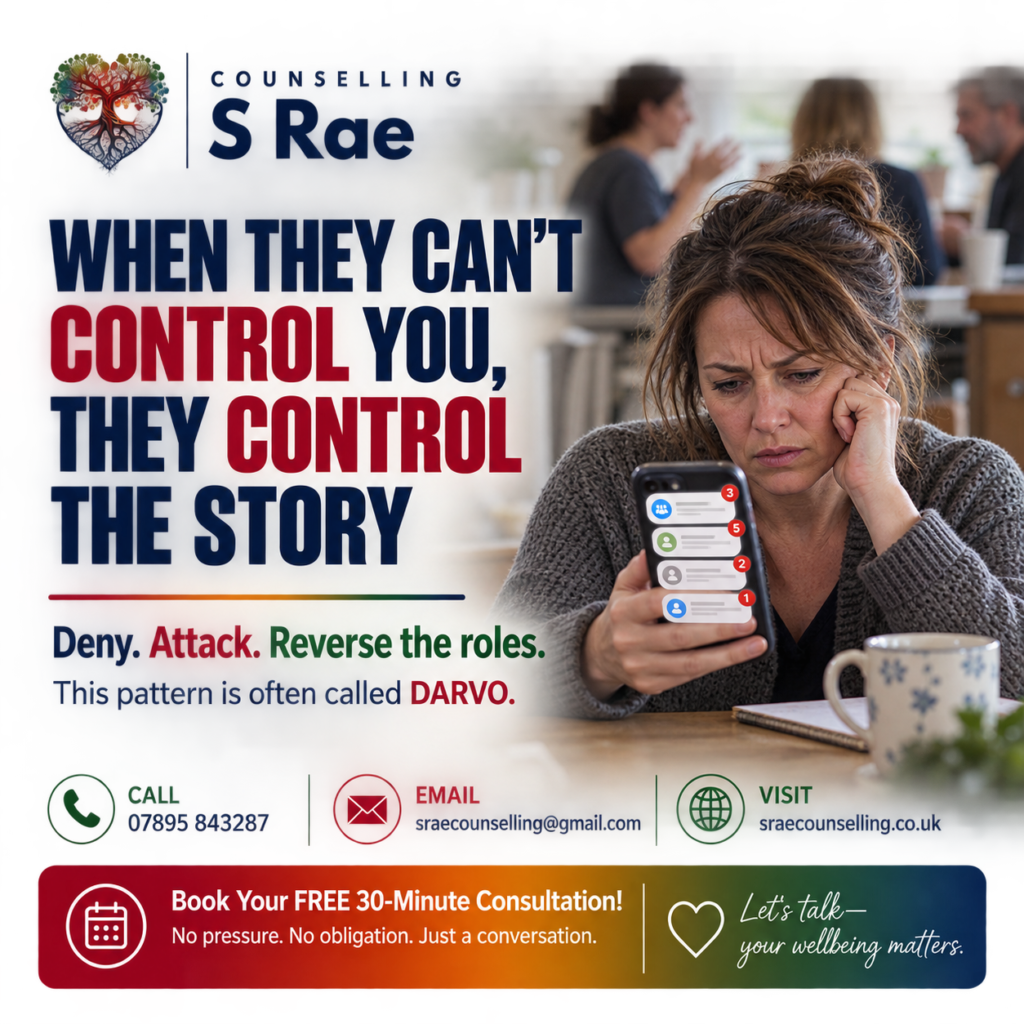
You raise a concern about someone’s behaviour, expecting a difficult but honest conversation.
Rather than acknowledging what occurred, they deny anything happened. Moreover, they attack your character, question your motives, or accuse you of causing the problem. Soon, they present themselves as the injured party. You are defending yourself against allegations you never expected, see https://sraecounselling.co.uk/darvo-controlling-the-story/.
This reversal can be deeply confusing.
You may start replaying conversations, collecting messages, explaining yourself repeatedly or questioning whether you have misunderstood everything.
There is a recognised term for this pattern: DARVO.
What does DARVO mean?
DARVO stands for:
- Deny
- Attack
- Reverse Victim and Offender
The term, introduced by psychologist Jennifer Freyd, describes a response when confronted about harm, https://sraecounselling.co.uk/darvo-controlling-the-story/
First, the person denies the behaviour or minimises its importance.
Next, they attack the credibility, character or motives of the person raising the concern.
Finally, they reverse the roles. The person who raised the issue is portrayed as the aggressor, while the person being confronted presents themselves as the victim.
It might sound like:
- “That never happened.”
- “You’re twisting everything.”
- “You’re the controlling one.”
- “Everyone can see what you’re doing to me.”
- “I’m the person being abused here.”
- “You’re only saying this to damage my reputation.”
However, a single defensive response does not automatically mean someone is using DARVO. People can remember events differently, react badly under pressure or firmly deny something they believe is untrue. See https://sraecounselling.co.uk/darvo-controlling-the-story/.
DARVO is better understood as a repeated pattern of avoiding responsibility through denial, attack and role reversal.
Why might someone try to control the story?
For some people, being held accountable feels unbearable.
Accepting responsibility could threaten how they see themselves, how other people see them or the control they hold within a relationship.
Rather than engaging with the original concern, they may shift attention towards your reaction, your character or your alleged behaviour.
The conversation is no longer about what they did.
It becomes about whether you are unstable, cruel, dishonest, vindictive or overly sensitive.
This change of focus can be highly effective because you may become so occupied with defending yourself that the original behaviour is never properly addressed.
Is DARVO the same as narcissism?
Not necessarily.
People often use the word “narcissist” to describe someone who is controlling, selfish or unwilling to accept responsibility. However, narcissistic personality disorder is a clinical diagnosis that cannot be established through a social-media post or one relationship conflict.
A person does not need a particular diagnosis to deny responsibility, attack someone’s credibility or reverse the roles.
The behaviour and its impact matter even when no diagnosis is known.
Instead of concentrating entirely on the label, it may be more helpful to ask:
- Does this person repeatedly avoid responsibility?
- Do concerns quickly become attacks on my character?
- Am I expected to defend myself instead of discussing what happened?
- Does their version of events change depending on the audience?
- Do I regularly leave conversations feeling confused or guilty?
- Are other people being recruited into the disagreement?
- Do apologies lead to change, or does the same pattern continue?
These questions focus on observable behaviour rather than attempting to diagnose another person.
Why does this pattern cause so much self-doubt?
When somebody confidently presents a completely different version of events, you may feel compelled to prove your experience.
You might search through old messages, ask friends what they remember or spend hours constructing the perfect explanation.
If the other person has already spoken to family, friends, colleagues or people online, the pressure can become even greater.
You may feel that remaining silent makes you look guilty, yet every response creates another opportunity for your words to be challenged or distorted.
Over time, this can affect your confidence in your own memory and judgement.
Feeling confused does not mean you are weak. It may mean you have been trying to make sense of two completely different versions of the same relationship.
What can help?
There is no single response that suits every situation, particularly where abuse, harassment, safeguarding concerns or legal allegations are involved.
Some helpful steps may include:
Return to the original issue
Notice when the conversation has moved away from the behaviour you raised and towards an attack on your personality.
You do not have to answer every accusation before your original concern can be discussed.
Keep communication clear
Short, factual communication may be more useful than lengthy emotional explanations.
Repeating yourself more forcefully does not always create understanding when the other person’s aim is to avoid responsibility.
Preserve relevant information
Where appropriate and lawful, keep important messages, emails, dates and records rather than relying entirely on memory.
This is particularly important if the situation involves threats, harassment, employment, children, finances or legal proceedings.
Choose carefully who receives an explanation
You do not have to win over every person who has heard a distorted version of events.
Consider who genuinely needs accurate information and who is simply being drawn into the conflict.
Seek independent support
A trusted friend, qualified counsellor, solicitor, GP or specialist support organisation may help you look at the situation more clearly.
The appropriate support depends on what is happening and whether there are concerns about safety, abuse or legal consequences.
If you believe you or somebody else is in immediate danger, contact the emergency services.
How can counselling help?
Counselling is not about deciding who has “won” an argument.
It can give you a confidential space to explore what happened and how the situation has affected you.
You may use counselling to:
- make sense of confusing relationship patterns;
- recognise manipulation or avoidance of responsibility;
- separate another person’s claims from your own experience;
- understand why certain accusations affect you so deeply;
- explore boundaries and communication;
- reduce shame and self-blame;
- rebuild trust in your memory and judgement;
- decide what you want to do next.
You do not need to prove that someone is a narcissist before discussing how their behaviour has affected you.
You can begin with what you experienced, how you feel and what you need now.
You are allowed to seek clarity
When someone repeatedly denies, attacks and reverses the roles, it can leave you feeling trapped inside their version of events.
You may not be able to control what another person says, believes or tells other people.
But you can begin to understand the pattern, reconnect with your own experience and decide how you want to respond.
Book your free 30-minute consultation
Take the first step towards better mental health with a free, no-obligation 30-minute consultation.
There is no pressure and no expectation—just an opportunity to talk and see whether counselling feels right for you.
📞 Call: 07895 843287
📧 Email: sraecounselling@gmail.com
🌐 Visit: sraecounselling.co.uk
Let’s talk—your wellbeing matters.