
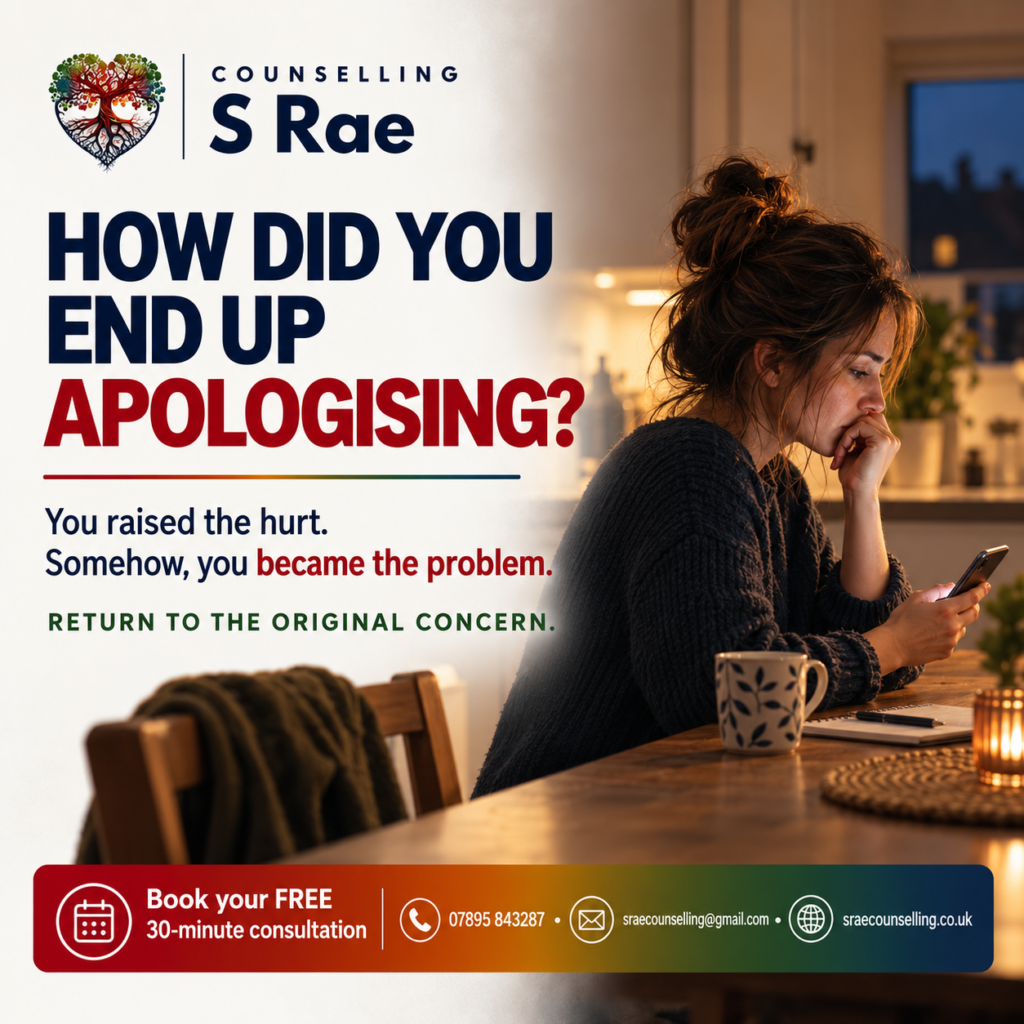
You entered the conversation hoping to explain that something had hurt you.
You may have chosen your words carefully, waited for a calm moment and tried not to sound accusatory. Yet, by the end, you were the one apologising.
How did the conversation turn around so completely?
When the original concern disappears
A constructive conversation should leave space for both people’s experiences. Someone can disagree with your interpretation while still listening to the effect the situation had on you.
However, some conversations follow a different pattern:
- You raise a concern.
- The behaviour is denied or minimised.
- Attention shifts towards your reaction.
- Your character or motives are questioned.
- The other person presents themselves as the injured party.
- You begin defending yourself or apologising.
- The original concern is never addressed.
This can happen so quickly that you may not notice the shift until the conversation is over.
How this may relate to DARVO
DARVO stands for Deny, Attack, and Reverse Victim and Offender.
The term describes a response in which somebody confronted about potentially harmful behaviour denies it, attacks the person raising the concern and reverses the roles.
DARVO is not a diagnosis, and noticing this pattern does not automatically prove which account is correct. Context, evidence and repeated behaviour remain important.
The value of understanding the pattern is that it helps you notice when a discussion about one behaviour becomes a trial of your entire character.
Why might you apologise?
You may apologise because:
- You want the conflict to stop.
- You fear losing the relationship.
- The other person appears extremely upset.
- You have been given several new accusations to answer.
- You want to demonstrate that you are reasonable.
- You feel responsible for other people’s emotions.
- You have begun doubting your memory.
- Previous disagreements have taught you that resistance makes things worse.
An apology made under emotional pressure does not necessarily mean you were responsible for the original problem.
Return to the original issue
When it feels safe, try calmly returning to the subject:
- “I’m willing to discuss that separately, but I would like to finish this issue first.”
- “I understand that you are upset. My original concern still needs to be addressed.”
- “We appear to be moving away from what I raised.”
- “I need some time before continuing this conversation.”
You do not have to resolve everything in one discussion.
If the conversation becomes aggressive, threatening or emotionally overwhelming, prioritise your safety rather than trying to deliver the perfect response.
How counselling may help
Repeated blame and role reversal can affect your confidence in your feelings, memory and right to speak.
Counselling may help you:
- Identify recurring conversational patterns
- Understand why you feel responsible for restoring peace
- Separate empathy from misplaced responsibility
- Develop clearer emotional boundaries
- Rebuild confidence in expressing your needs
- Consider your choices without pressure
You are allowed to care about another person’s feelings without abandoning your own.
S Rae Counselling offers a free, no-obligation 30-minute consultation.
Call 07895 843287, email sraecounselling@gmail.com or visit sraecounselling.co.uk.