
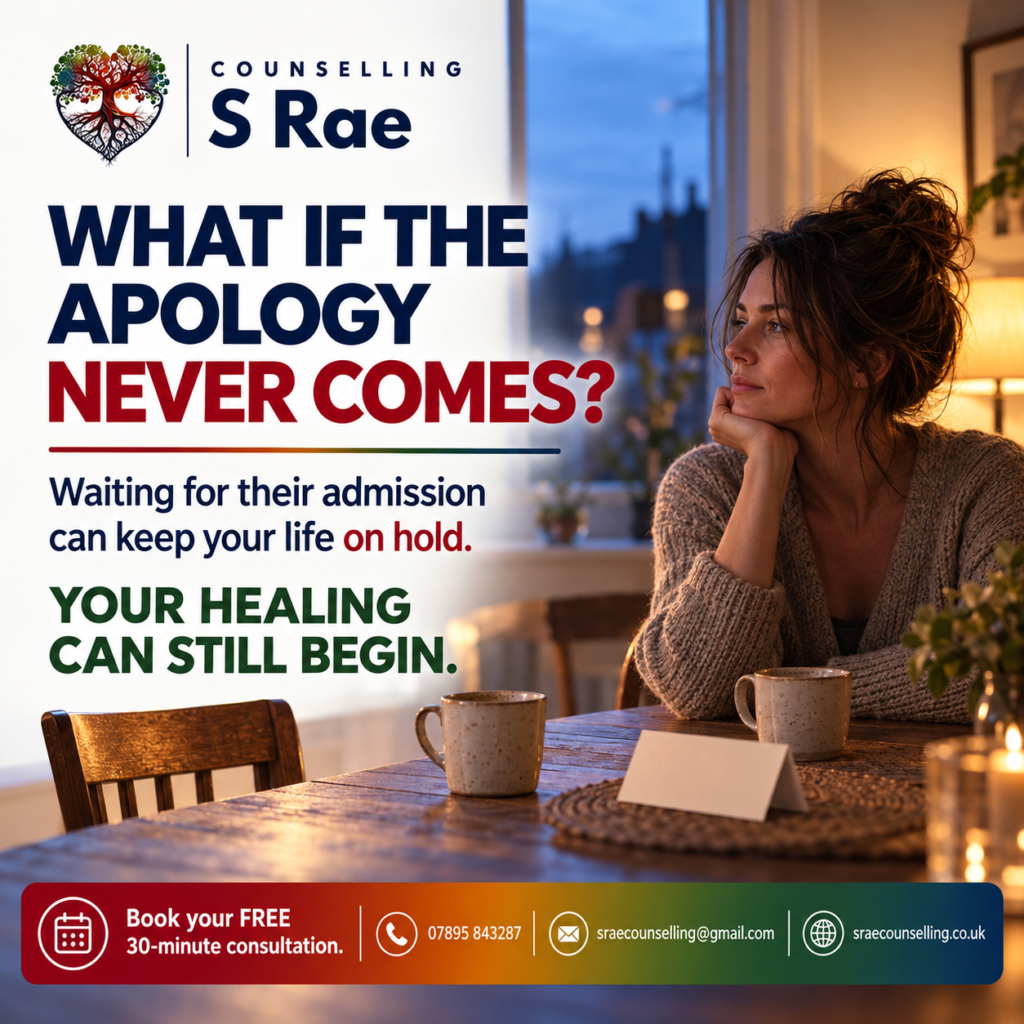
An apology can represent more than a few words.
It may offer confirmation that the experience was real, that your pain mattered and that you were not wrong for raising it.
When an apology never comes, you may feel unable to put the experience down.
Why does acknowledgement matter?
Being acknowledged can help repair trust after harm.
A meaningful apology usually involves:
- Clearly recognising the behaviour
- Listening to its effect
- Accepting appropriate responsibility
- Expressing genuine regret
- Making reasonable amends
- Demonstrating change over time
Without these elements, “sorry” may feel empty or create further confusion.
If unresolved conflict is affecting your emotional wellbeing, relationship counselling with S Rae provides space to explore the effect without being pressured towards a particular decision.
When the apology shifts responsibility
Some apologies appear to acknowledge harm while quietly returning the blame:
- “I’m sorry you feel that way.”
- “I’m sorry, but you made me angry.”
- “I already apologised, so you need to move on.”
- “I’m sorry you misunderstood me.”
- “We both did things wrong.”
These statements may not address the behaviour or its effect.
Research has also examined how DARVO and insincere apologies may influence other people’s perceptions. Jennifer Freyd’s official overview of DARVO research provides links to this work and explains the limits of what the research establishes.
You are not obligated to treat every use of the word “sorry” as proof that the issue has been resolved.
Why you may continue waiting
You may hope an apology will:
- Confirm your memory
- Restore your reputation
- Prove that you were not responsible
- Repair the relationship
- Help other people understand
- Give you permission to move forward
- Return the person you hoped they would be
These needs are understandable. The difficulty arises when recovery becomes entirely dependent upon someone who may be unwilling or unable to provide that acknowledgment.
S Rae’s article on why one comment can stay with us for days explores how the mind can repeatedly return to emotionally significant words and interactions.
Acceptance is not approval
Accepting that an apology may never come does not mean approving of what happened.
It means recognising what is currently within your control.
You may not control whether another person takes responsibility. You can decide what support you seek, what boundaries you establish and how you care for yourself now.
Creating your own form of closure
Closure is not always one final conversation. It may develop gradually through:
- Naming what happened honestly
- Allowing yourself to feel the loss
- Writing what you wish had been acknowledged
- Establishing boundaries
- Ending repeated attempts to obtain an admission
- Reconnecting with safe people
- Making choices that reflect your values
- Seeking counselling or appropriate professional support
The NHS counselling guide explains how counselling can help people discuss emotional difficulties and explore their own solutions.
Moving forward does not erase the past. It changes how much power the past holds over your present.
Their apology belongs to them.
Your recovery belongs to you.
To explore support without pressure or obligation, book a free 30-minute consultation.