
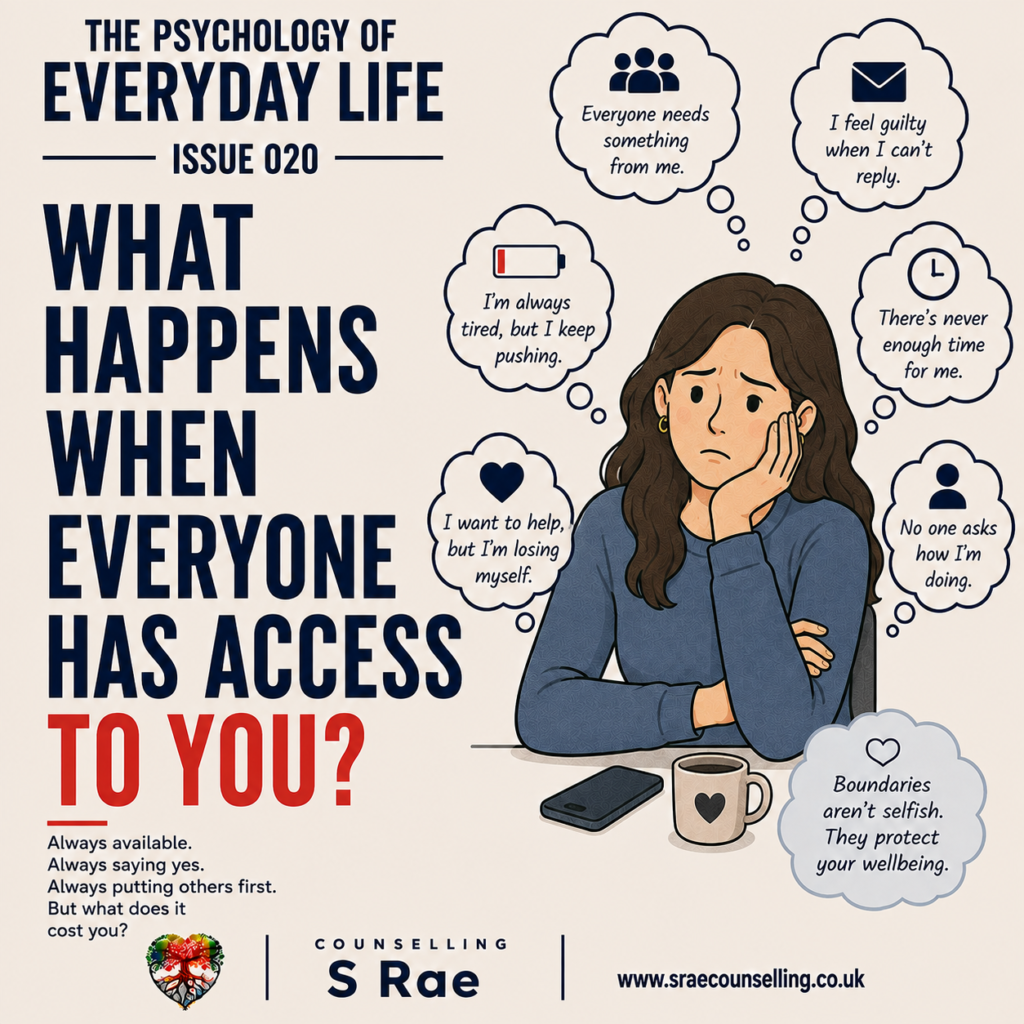
Understanding constant availability, emotional exhaustion and why boundaries protect rather than damage relationships
What happens when everyone has access to you, but you rarely have enough time or energy for yourself?
You may answer messages as soon as they arrive, agree to plans when you need rest and make yourself available whenever someone is struggling.
Perhaps you are the person everyone contacts when they need advice, reassurance, practical help or somewhere to release their emotions.
Being trusted can feel meaningful. Helping people can bring connection and purpose.
But when availability stops being a choice, kindness can slowly become exhaustion.
Your thoughts may sound like:
“I should reply now.”
“They need me.”
“I’ll feel guilty if I say no.”
“What if they think I don’t care?”
“I can rest once everyone else is okay.”
The problem is that everyone else may never be completely okay. There will always be another message, need, request or problem.
Without limits, your own wellbeing can remain permanently postponed.
What Does It Mean When Everyone Has Access to You?
Being accessible does not only mean answering your phone.
It may involve giving people unrestricted access to your:
- Time
- Attention
- Emotional energy
- Personal space
- Availability outside working hours
- Ability to solve problems
- Willingness to listen
- Home or private life
- Immediate responses
- Capacity to change your plans
People may begin to expect that you will always answer, always help and always make room.
You may also begin expecting this from yourself.
The arrangement can develop gradually. One quick favour becomes a regular responsibility. Answering one late-night message creates the expectation that you are available every night.
Nobody may have formally demanded constant access. It may emerge because you rarely communicate when you are unavailable.
Why Do We Make Ourselves Constantly Available?
There is rarely one explanation.
We may remain available because:
- We want to feel needed
- Helping gives us a sense of worth
- We fear disappointing people
- We want to prevent conflict
- We worry that relationships will weaken without constant contact
- We have learned to put other people first
- We feel responsible for other people’s emotions
- Saying no feels selfish
- We are afraid someone will struggle without us
For some people, being helpful became closely connected with being accepted.
They may have learned:
“People value me when I make life easier for them.”
“My needs should not inconvenience anyone.”
“If someone is upset, I need to fix it.”
“If I am not available, I am letting them down.”
These beliefs can make even a reasonable boundary feel like rejection.
Being Needed Can Feel Like Being Valued
When someone repeatedly turns to us, it can create a strong sense of importance.
We may feel:
“They trust me.”
“I am useful.”
“I matter to them.”
There is nothing wrong with enjoying being supportive. The difficulty begins when being needed becomes the main evidence that we are valuable.
We may then fear that setting a boundary will change how people see us:
“If I stop helping, will they still want me around?”
“Will they find someone else?”
“What do I offer if I am not solving problems?”
This can keep us giving long after we have reached our emotional limit.
Healthy relationships should include appreciation for who we are—not only gratitude for what we provide.
Constant Access Can Create Emotional Exhaustion
When we repeatedly respond to other people’s needs without enough opportunity to recover, our emotional resources can become depleted.
We may feel:
- Constantly tired
- Irritable
- Emotionally numb
- Unable to concentrate
- Resentful
- Overwhelmed by ordinary requests
- Guilty for wanting space
- Unable to switch off
- Responsible for everyone
- Disconnected from our own needs
Extended availability and difficulty disengaging from demands have been associated with poorer wellbeing, work-life imbalance and emotional exhaustion. Research into boundary management describes psychological detachment—being able to mentally disengage from demands—as an important part of recovery.
This does not mean that caring for people automatically causes burnout.
The risk grows when the emotional demands are frequent, the responsibility feels endless and there is little opportunity to rest or receive support ourselves.
You May Stop Recognising Your Own Needs
When we are constantly responding to other people, our attention becomes externally focused.
We notice:
- Who needs a reply
- Who seems upset
- What task needs completing
- Whether someone is disappointed
- What problem might happen next
We may become highly skilled at recognising everyone else’s emotional state while struggling to answer:
“What do I need?”
We may not notice our limits until we are completely exhausted.
Hunger, tiredness, frustration and a need for quiet can be ignored because someone else’s situation feels more urgent.
Eventually, even small requests can feel unbearable—not because the request is unreasonable, but because there is no remaining capacity.
Why Do Messages Create So Much Pressure?
Phones have made us contactable almost everywhere.
A message can reach us at work, at home, during meals, late at night or while we are trying to rest.
The fact that we have received a message can create the feeling that we must respond immediately.
We may think:
“They can see I’ve read it.”
“They’ll wonder why I haven’t replied.”
“It will only take a minute.”
But one minute can become a longer conversation, an emotional responsibility or another task added to the day.
Receiving a message does not automatically create an obligation to respond immediately.
Availability is not the same as capacity.
You can physically have your phone nearby and still not have the emotional energy to engage.
Guilt Can Make Boundaries Feel Wrong
When we begin limiting access, guilt often appears.
We may worry that we are becoming:
- Selfish
- Distant
- Unreliable
- Unkind
- Difficult
- Less supportive
But guilt does not always mean we have done something wrong.
Sometimes it means we have done something unfamiliar.
If you are used to putting yourself last, a healthy limit may initially feel uncomfortable because it challenges an established role.
A helpful question is:
“Am I harming this person—or am I simply no longer meeting every request immediately?”
Another person’s disappointment does not automatically mean your boundary is unfair.
Boundaries Are Not Rejection
A boundary communicates where your availability begins and ends.
It may sound like:
“I’m not able to talk tonight.”
“I’ll reply when I have more capacity.”
“I can listen for ten minutes, but then I need to rest.”
“I cannot take responsibility for this decision.”
“I’m unavailable outside my working hours.”
“I care about you, but I’m not the right person to support you with this.”
Healthy boundaries allow us to express our needs while remaining respectful of others. NHS and Mental Health Foundation guidance identifies boundaries and honest communication as important parts of healthy relationships and mental wellbeing.
A limit does not necessarily mean:
“I do not care.”
It may mean:
“I want to remain connected without becoming emotionally depleted.”
Constant Availability Can Create Resentment
When we repeatedly agree to things we do not have the capacity for, resentment can build.
We may begin thinking:
“Why does everyone always come to me?”
“Why does nobody ask how I am?”
“Why can’t they solve this themselves?”
But other people may not realise that we are overwhelmed.
They may assume our availability is freely offered because we continue saying yes.
Unspoken resentment often grows around a boundary we have not communicated.
Setting limits earlier can be kinder than continuing to agree and gradually becoming angry, withdrawn or emotionally unavailable.
People May Become Dependent on Your Availability
When we regularly solve someone’s problems, make decisions for them or respond to every crisis, they may begin relying on us more than is healthy for either person.
Our help may unintentionally communicate:
“You cannot manage this without me.”
We may also begin feeling indispensable:
“If I step back, everything will fall apart.”
Support is most sustainable when it encourages another person’s agency rather than replacing it.
NHS Scotland guidance on boundaries cautions against “rescuing”—taking responsibility for another person’s problems or decisions—and instead recommends helping people access information and confidence to make their own choices.
You can care without becoming responsible for every outcome.
Why Do We Feel Guilty When We Cannot Reply?
A delayed response can feel emotionally significant when we associate immediacy with care.
We may believe:
“If I cared, I would answer now.”
But care is not measured by response speed.
You may care deeply and still be:
- Working
- Sleeping
- Spending time with your family
- Emotionally drained
- Managing your own difficulty
- Unable to provide the support required
A more balanced belief might be:
“I can care about this person without being continuously available.”
When Nobody Asks How You Are
People who are consistently strong and helpful are sometimes assumed to be coping.
Others may think:
“They’ll tell me if something is wrong.”
“They always manage.”
“They’re the one who supports everyone.”
This can leave the supportive person feeling invisible.
They may quietly wonder why nobody offers them the same attention they provide to others.
Sometimes other people genuinely fail to notice. At other times, we have become so practised at hiding our needs that nobody realises support is required.
This does not mean you are to blame for feeling overlooked.
It may mean a different kind of honesty is needed:
“I’ve been supporting a lot of people recently, and I’m feeling drained.”
“I could use someone checking in with me too.”
“I’m not doing as well as I appear.”
Access Should Be Earned Through Trust
Not everyone needs the same level of access to you.
Different relationships can have different boundaries.
You may be comfortable sharing personal feelings with a close friend while keeping a professional relationship more limited.
You might respond quickly to an urgent family matter but leave routine messages until later.
Consider whether a person:
- Respects your no
- Accepts delayed replies
- Listens to your needs
- Keeps private information confidential
- Offers mutual support
- Uses guilt or pressure
- Expects access without considering your wellbeing
Closeness should involve trust and reciprocity—not entitlement.
How to Reduce Constant Availability
You do not need to disappear or create rigid rules overnight.
Small changes can help you regain a sense of choice.
Delay Your Response
You do not need to reply the moment a message arrives.
Allow yourself time to check:
- Do I have the energy?
- Is this urgent?
- Am I the right person to help?
- Do I want to respond now?
- Would a later reply be more thoughtful?
Create Contact-Free Periods
Choose times when you are not available for non-urgent communication.
This might include:
- During meals
- After a certain evening time
- During work
- While resting
- One part of the weekend
- The first hour after waking
You do not need to be reachable every moment to be caring.
Communicate the Boundary Clearly
You might say:
“I don’t always reply immediately, but I’ll respond when I can.”
“I’m switching off for the evening.”
“I’m not able to discuss this tonight.”
“I need some time to myself.”
Direct communication reduces the need for other people to guess.
Stop Overexplaining
A boundary does not always require a detailed defence.
“I’m not available” can be enough.
Long explanations may invite negotiation or communicate that the boundary only applies when your reason is considered acceptable.
Offer What You Can Genuinely Give
A boundary does not always need to be a complete refusal.
You might say:
“I can talk for fifteen minutes.”
“I cannot help today, but I can check in tomorrow.”
“I can listen, but I’m not able to solve this.”
Only offer an alternative when you genuinely have the capacity.
Let Other People Solve Their Own Problems
Pause before stepping in.
Ask:
“Have they actually requested my help?”
“Is this my responsibility?”
“Could they manage this themselves?”
“Am I supporting—or rescuing?”
Sometimes the most respectful response is allowing another person to discover their own ability.
What If People React Badly?
People who have benefited from unrestricted access may not immediately welcome a boundary.
They may:
- Question your decision
- Act disappointed
- Continue asking
- Call you selfish
- Suggest that you have changed
- Attempt to create guilt
Their reaction does not automatically prove the boundary is wrong.
You can respond calmly:
“I understand that this is different, but I need more time for myself.”
“I care about you, but I cannot always be immediately available.”
“I’m still willing to support you within what I can realistically manage.”
Healthy relationships can adapt to reasonable boundaries.
Relationships that depend on your exhaustion may become more difficult when you stop overextending yourself.
Boundaries Can Improve Relationships
Boundaries are sometimes imagined as walls that push people away.
In reality, they can make connection more honest and sustainable.
When you have permission to say no:
- Your yes becomes more genuine
- Support is offered willingly
- Resentment is less likely to build
- Expectations become clearer
- Both people’s needs can be recognised
- Time together may feel more meaningful
The Mental Health Foundation identifies communication and boundaries as important elements of healthy relationships, while NHS guidance notes that open communication can strengthen connection and protect wellbeing.
You Are Allowed to Be Unavailable
You are allowed to:
- Leave a message unanswered until tomorrow
- Rest without earning it
- Protect time with your family
- Change your plans less often
- Decline emotional conversations when you are depleted
- Ask someone else to take responsibility
- Have needs of your own
- Be unavailable without becoming unkind
Your time and emotional energy are not unlimited public resources.
They belong to you.
Counselling Support
When people-pleasing, guilt or fear of disappointing others makes it difficult to establish boundaries, counselling can provide a safe place to understand why constant availability feels necessary.
Together, we can explore the beliefs and experiences that make saying no feel unsafe, while developing boundaries that protect your wellbeing without abandoning the relationships that matter to you.
Book Your FREE 30-Minute Consultation
Take the first step towards better mental health with a free, no-obligation 30-minute consultation. We’re here to listen and support you.
📞 Call: 07895 843287
📧 Email: sraecounselling@gmail.com
🌐 Visit: sraecounselling.co.uk
Let’s talk—your wellbeing matters. 💙
Further Reading
- NHS: Maintaining healthy relationships and mental wellbeing
- Mental Health Foundation: A guide to investing in your relationships
- Mental Health Foundation: Building and maintaining healthy relationships
- NHS South West London: Self-care and healthy boundaries
- NHS Scotland: Establishing boundaries and avoiding rescuing
- Research review: After-hours availability, disconnection and wellbeing