
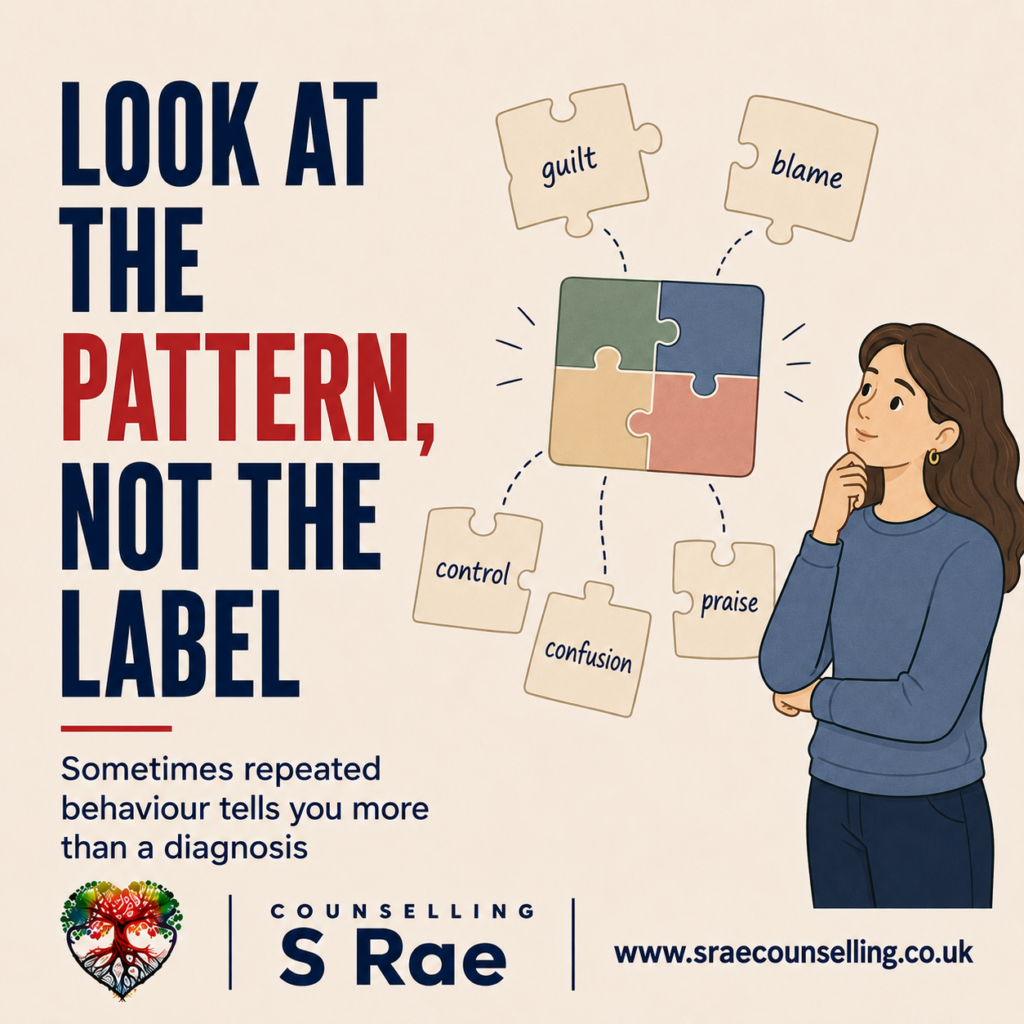
“Are they a narcissist?”
“Are they gaslighting me?”
“Are they controlling?”
These are understandable questions when a relationship begins making you uncomfortable.
Sometimes having a name for behaviour can provide clarity.
But labels can also distract us from something more important:
What is actually happening repeatedly?
One Incident Doesn’t Define Someone
Someone behaving selfishly does not automatically make them a narcissist.
Someone remembering an event differently doesn’t automatically make them a gaslighter.
Someone being upset with you doesn’t automatically mean they’re controlling.
People have bad days.
People communicate badly.
People make mistakes.
The concern is when particular behaviours repeatedly appear.
Look for Repetition
Ask yourself:
Do they regularly need recognition for everything they do?
Are previous mistakes repeatedly brought into new disagreements?
Do they struggle to apologise?
Does every argument somehow become your fault?
Are favours later used against you?
Do you frequently feel guilty for saying no?
Do you find yourself questioning your own memory after conversations?
Do you avoid raising concerns because you know what will happen?
These patterns can tell you far more than a single incident.
Pay Attention to How You Feel
Another useful question is how the relationship consistently leaves you feeling.
Do you feel respected?
Can you disagree safely?
Can you make mistakes without being permanently punished?
Can you say no?
Can you express hurt without immediately becoming the person who needs to apologise?
Or do you frequently leave conversations feeling guilty, confused, inferior or emotionally exhausted?
You Don’t Need to Diagnose Someone
Understanding relationship patterns isn’t about diagnosing another person.
Only appropriately qualified professionals can diagnose personality disorders.
You don’t need a diagnosis to decide that someone’s behaviour is having a negative effect on you.
Sometimes recognising the pattern is enough.
It may allow you to establish boundaries, communicate differently or explore how the relationship is affecting your emotional wellbeing.
The most useful question therefore may not be:
“What label should I give this person?”
It may be:
“What is this relationship doing to me?”