
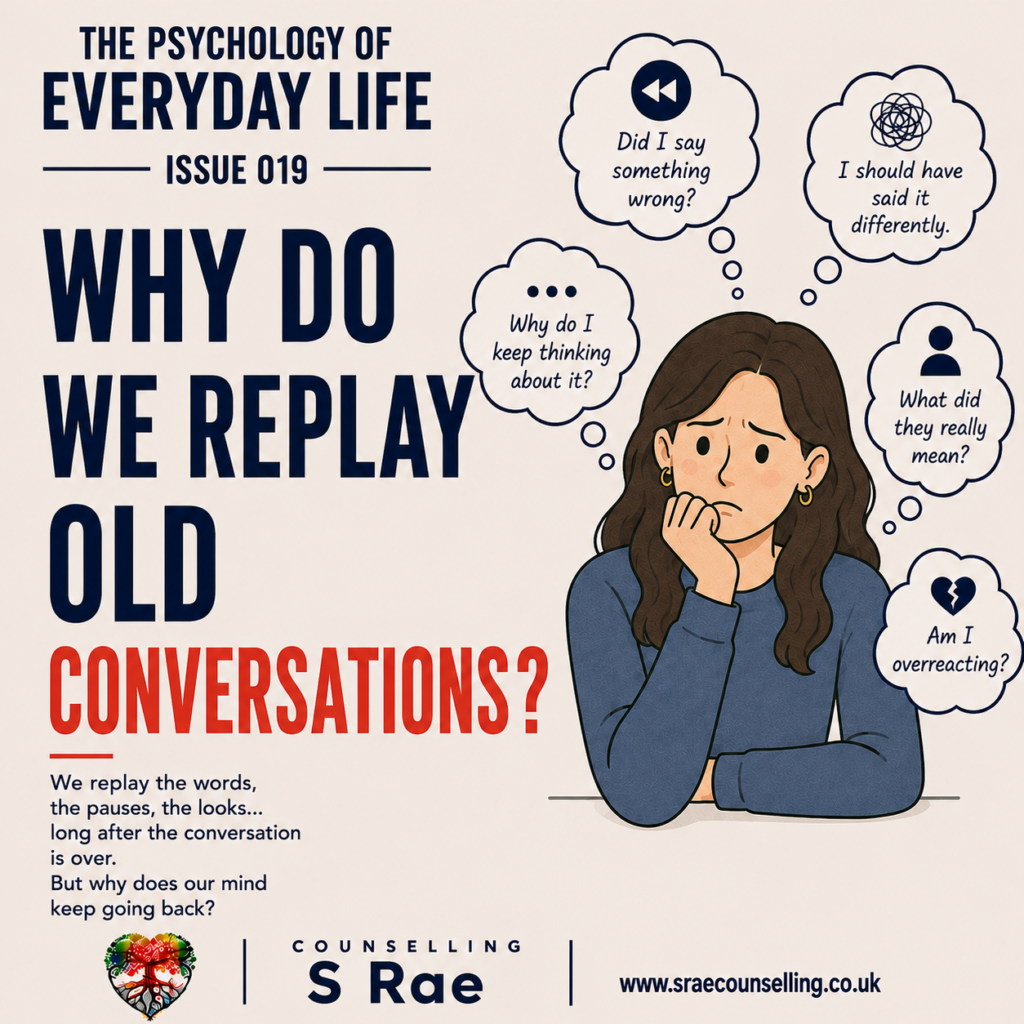
Understanding why our minds return to past interactions—and why thinking harder does not always bring clarity
Why do we replay old conversations long after the interaction has ended?
Perhaps someone made a brief comment that felt unusual. Maybe we stumbled over our words, noticed a change in their expression or left the conversation without knowing what they thought.
Hours later, our mind begins reviewing everything:
“Did I say something wrong?”
“Why did they pause before answering?”
“Did I sound awkward?”
“What did they really mean?”
“I should have responded differently.”
We may analyse every word, pause and look in the hope of finding certainty. Yet instead of reaching a clear conclusion, we often become more anxious and self-critical.
This repetitive review is sometimes described as rumination or post-event processing. Rumination involves repeatedly returning to negative thoughts or feelings without reaching a satisfactory solution. Post-event processing refers more specifically to reviewing a social interaction, often with a focus on perceived mistakes or signs of failure.
Replaying a conversation does not mean you are dramatic or unable to let things go. Your mind may be trying to understand what happened, protect you from future embarrassment or resolve uncertainty that still feels unfinished.
Why Do We Replay Old Conversations?
Conversation moves quickly.
While speaking, we are listening, interpreting tone, watching facial expressions, choosing our own words and deciding how much to share. We may not fully understand how we felt until the interaction is over.
Later, when there is more time, the mind returns to the event.
It may be trying to answer questions such as:
- Was I accepted?
- Did I offend anyone?
- Was I misunderstood?
- Did I reveal too much?
- Should I have spoken differently?
- Is the relationship still secure?
From the mind’s perspective, reviewing the conversation may feel useful. It appears to offer another opportunity to identify what went wrong and prevent the same thing happening again.
The difficulty is that the past cannot provide any new information. We are trying to solve an uncertain situation using the same limited evidence.
Our Minds Dislike Social Uncertainty
When a conversation feels clear and comfortable, we may not think about it again.
Replaying becomes more likely when something feels ambiguous.
Perhaps the other person:
- Gave a short answer
- Looked away
- Changed the subject
- Took longer than usual to reply
- Used a tone we could not interpret
- Ended the conversation unexpectedly
- Did not offer the reassurance we expected
Ambiguity leaves room for interpretation.
The mind may fill that space with explanations:
“They were annoyed.”
“They thought I was boring.”
“I embarrassed myself.”
“They don’t like me anymore.”
These explanations may feel convincing, but they remain assumptions.
The person may have been distracted, tired, worried about something unrelated or simply unsure how to respond.
A pause is not proof of rejection. A facial expression is not a complete explanation.
Replaying Can Be an Attempt to Prevent Future Pain
Our minds learn from social experiences.
If we believe a conversation went badly, reviewing it may seem like a way of preparing for the future.
We tell ourselves:
“If I understand exactly what happened, I won’t make the same mistake again.”
“If I find the perfect response, I’ll know what to say next time.”
“If I examine every detail, I can protect myself from rejection.”
This gives rumination a problem-solving quality.
But genuine reflection usually moves towards understanding or action. Rumination tends to repeat the same questions without producing anything new.
It may feel productive because the mind is busy. In reality, we can remain trapped in the same uncertainty.
Social Anxiety Can Strengthen Post-Conversation Analysis
People who worry about being judged may be especially likely to review social interactions afterwards.
A 2024 systematic review found a moderate association between post-event rumination and social-anxiety symptoms. People experiencing greater social anxiety may spend longer reviewing interactions and evaluate their own performance more negatively.
During the conversation, they may monitor themselves closely:
“Am I speaking too much?”
“Do I look nervous?”
“Was that answer strange?”
Afterwards, the monitoring continues:
“I knew I sounded awkward.”
“They must have noticed.”
“I should have stayed quiet.”
The review may then be treated as evidence that the interaction went badly, even though it is being filtered through fear and self-criticism.
Research suggests that post-event processing can contribute to ongoing social anxiety by increasing anxiety after interactions and encouraging the recall of previous situations interpreted as social failures.
We Often Remember the Conversation Through Our Feelings
Memory is not a perfect recording.
We do not store every detail exactly as it happened and then play it back objectively. What we notice and remember can be influenced by how anxious, embarrassed or uncertain we felt.
If we left a conversation feeling uncomfortable, we may later remember it as more negative than it appeared to anyone else.
We might focus on:
- One sentence that sounded wrong
- A pause that felt too long
- A moment when we lost our train of thought
- An expression we could not interpret
- Something we forgot to say
Meanwhile, we may overlook evidence that the interaction was fine:
- The other person continued talking
- They laughed or responded warmly
- They shared something personal
- They suggested speaking again
- They may not have noticed the moment we are analysing
Studies of post-event processing have found that repeated negative review can be associated with more negative evaluations of social performance.
Why Do We Imagine Better Responses?
One of the most familiar parts of replaying a conversation is creating the response we wish we had given.
“I should have challenged that.”
“I should have explained myself.”
“I should have been funnier.”
“I should have said nothing.”
Imagining another response can briefly restore a sense of control. In our revised version, we are calmer, more confident and perfectly articulate.
But we are comparing the real version of ourselves—responding in the moment—with an imaginary version who has unlimited time, hindsight and no emotional pressure.
That comparison is not fair.
The response that appears obvious hours later may not have been available when we were surprised, nervous or trying to process what was happening.
Conversations Can Feel Unfinished
Some interactions stay with us because there was no clear resolution.
Perhaps we:
- Froze and did not respond
- Agreed when we wanted to disagree
- Felt criticised but said nothing
- Realised later that a comment hurt
- Were interrupted before finishing
- Left without knowing where we stood
The mind may continue returning to the interaction because it feels incomplete.
In some situations, a follow-up conversation may help.
You might say:
“I’ve been thinking about our conversation and wanted to clarify something.”
“I didn’t explain myself very well earlier.”
“That comment stayed with me. Could you tell me what you meant?”
However, not every conversation needs to be reopened. Sometimes the need for certainty comes from anxiety rather than an unresolved practical issue.
Replaying Is Not Always the Same as Reflection
Reflection can be helpful.
It allows us to consider what happened, understand our feelings and decide whether anything needs to change.
Helpful reflection might sound like:
“I interrupted them several times. Next time I want to slow down and listen.”
“I agreed because I felt pressured. I may need to communicate a boundary.”
“That comment upset me. I want to discuss it with them.”
Rumination sounds more like:
“Why am I always so awkward?”
“They probably think badly of me.”
“I ruin every conversation.”
“I need to keep analysing this until I know for certain.”
Reflection is usually specific and balanced. Rumination becomes global, repetitive and increasingly critical.
A useful question is:
“Has this thought given me any new information?”
When the answer is no, continuing to review the conversation may not bring the clarity you are seeking.
We May Be Trying to Read Another Person’s Mind
Much of post-conversation analysis involves guessing what someone else thought.
We may believe:
“They thought I was rude.”
“They could tell I was nervous.”
“They regretted speaking to me.”
But unless they told us, we do not know.
This is sometimes called mind-reading: treating an assumption about another person’s thoughts as though it were a fact.
Ask yourself:
What did I observe?
“They gave a short reply.”
Then ask:
What did I assume?
“They were annoyed with me.”
Separating observation from interpretation can reduce the certainty attached to the negative conclusion.
Why Reassurance Does Not Always Stop the Cycle
We may tell a friend what happened and ask:
“Do you think I said something wrong?”
Their reassurance provides temporary relief.
But the doubt may soon return:
“Maybe they’re only trying to make me feel better.”
“Perhaps I didn’t explain it properly.”
“What if they missed something?”
Repeated reassurance may calm the immediate anxiety without resolving the underlying fear of judgement or uncertainty.
The goal is not always to prove that the conversation went perfectly. It may be learning that we can tolerate not knowing exactly what another person thought.
How Replaying Conversations Affects Us
Occasional reflection is normal.
The pattern becomes more difficult when it:
- Interrupts sleep
- Affects concentration
- Changes our mood for hours or days
- Makes us avoid certain people
- Creates fear before future conversations
- Leads to repeated reassurance-seeking
- Causes harsh self-criticism
- Makes ordinary interactions feel threatening
Rumination can become exhausting and contribute to cycles of stress and low mood. NHS resources describe it as an inward focus on negative thoughts that can become habitual and reduce engagement with more beneficial activities.
How Can We Stop Replaying Old Conversations?
Trying to force a thought away often makes us notice it more.
A more helpful approach is to recognise the pattern and gently redirect attention.
Name the Process
Tell yourself:
“I am replaying the conversation.”
“This is rumination, not new information.”
Naming the process creates distance between you and the thought.
You are noticing what your mind is doing rather than accepting every conclusion it produces.
Write Down the Facts
Create two sections:
What actually happened
What I am assuming
For example:
Fact: They paused before replying.
Assumption: They thought my answer was stupid.
This helps reveal how much of the distress comes from interpretation rather than confirmed information.
Ask Whether There Is an Action to Take
Consider:
“Is there something practical I need to do?”
Perhaps you need to apologise, clarify, communicate a boundary or make a note for next time.
When there is a useful action, take it.
When there is no action, further analysis may simply repeat the discomfort.
Give Reflection a Time Limit
Set aside ten minutes to think or write about the conversation.
When the time ends, deliberately move to another activity.
This acknowledges that the event affected you without allowing it to control the entire evening.
Shift From “Why?” to “What Now?”
Questions such as “Why did I say that?” can keep the mind circling.
Try asking:
“What would help me now?”
“What can I learn?”
“What would I like to do differently next time?”
“What do I need to let remain uncertain?”
These questions move attention towards the present.
Use a Balanced Response
Replace:
“I completely embarrassed myself.”
with:
“I felt awkward for a moment, but that does not mean the entire conversation went badly.”
Replace:
“They definitely think badly of me.”
with:
“I cannot know exactly what they thought, and there may be several explanations.”
A balanced thought does not pretend everything was perfect. It prevents one uncertain moment from becoming a complete judgement.
Redirect Attention Gently
Choose an activity that requires engagement:
- Take a walk
- Complete a practical task
- Speak to someone about a different subject
- Listen closely to music
- Read
- Use a grounding exercise
- Write down what you are grateful for in the present moment
The purpose is not to avoid every feeling. It is to stop repeatedly feeding the same thought once reflection has stopped being useful.
Mindfulness-based approaches aim to change our relationship with repetitive thoughts by helping us notice them without automatically becoming absorbed in them.
What If You Did Say Something Wrong?
Sometimes we genuinely make mistakes.
We may interrupt, speak carelessly, misunderstand someone or react defensively.
Recognising this does not require hours of self-punishment.
You can ask:
- Do I need to apologise?
- Can I clarify what I meant?
- What can I learn from the interaction?
- How can I behave differently next time?
An appropriate apology may sound like:
“I’ve thought about what I said earlier, and I’m sorry. It came across badly.”
Taking responsibility is different from repeatedly attacking yourself.
Once you have learned, repaired what you can and made a different plan, continued punishment does not make the apology more sincere.
You Are Allowed to Be Imperfect in Conversation
Real conversations are rarely polished.
People pause, interrupt, misunderstand, become nervous, forget words and think of better responses later.
A good conversation is not one in which every sentence is perfect.
It is one in which there is enough safety for people to clarify, repair and continue.
You do not need to communicate flawlessly to deserve connection.
When Might Support Help?
Support may be useful when replaying conversations regularly affects your sleep, confidence, relationships or willingness to socialise.
It may also help when the thoughts are connected to:
- Persistent social anxiety
- Low self-esteem
- Fear of rejection
- Previous criticism or bullying
- Perfectionism
- Difficulty tolerating uncertainty
- Repeated reassurance-seeking
Repetitive negative thinking is associated with several forms of psychological distress, but it is a thinking process—not proof of any single diagnosis.
A counsellor can help you understand why particular interactions feel threatening and develop a more compassionate way of responding to uncertainty.
Counselling Support
When old conversations continue long after they have ended, counselling can provide a safe place to explore the fears beneath the replay.
Together, we can look at self-criticism, fear of judgement and the experiences that taught you to examine every interaction so closely.
You do not have to solve every conversation alone in your head.
Book Your FREE 30-Minute Consultation
Take the first step towards better mental health with a free, no-obligation 30-minute consultation. We’re here to listen and support you.
📞 Call: 07895 843287
📧 Email: sraecounselling@gmail.com
🌐 Visit: sraecounselling.co.uk
Let’s talk—your wellbeing matters. 💙
Further Reading
- Anxiety – Every Mind Matters – NHS
- NHS guidance explaining rumination and repetitive thinking.
- A systematic review of post-event rumination and social anxiety.
- Research examining how post-event processing can maintain negative self-evaluations.
- NHS information about mindfulness-based approaches to worry and rumination.