
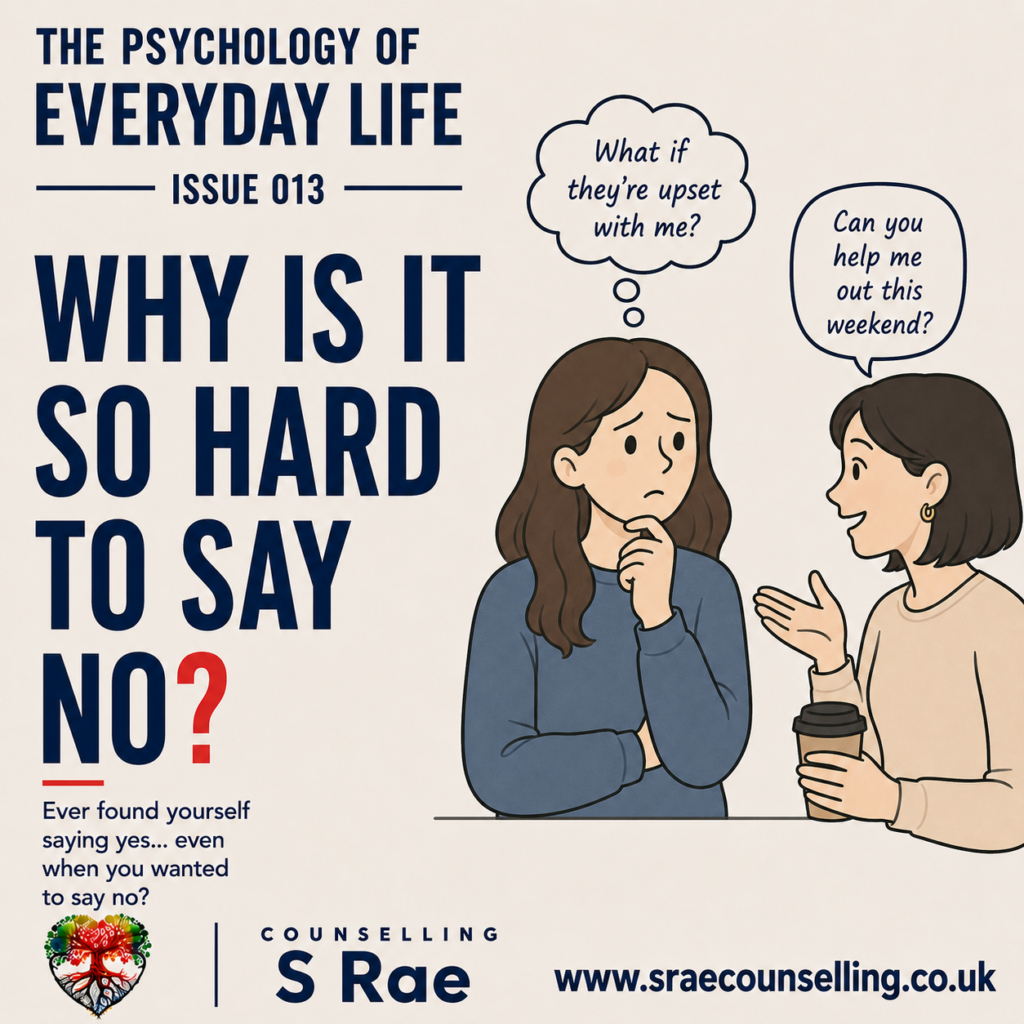
Issue 013 — Blog Post
Why Is It So Hard to Say No?
Understanding guilt, people-pleasing and why setting a boundary can feel like rejection
Why is it so hard to say no, even when we are already exhausted, overwhelmed or unable to take on anything else?
Someone asks for our time, help or attention. We know that agreeing will place more pressure on us, but the word “no” still feels uncomfortable.
Our thoughts may immediately begin warning us:
“What if they think I’m selfish?”
“What if I disappoint them?”
“What if they become angry?”
“What if they stop asking me?”
We may say yes before we have properly considered the request. Afterwards, we feel drained, frustrated or resentful—not necessarily because someone asked, but because we ignored what we genuinely needed.
Finding it hard to say no does not mean you are weak or uncaring. It may reflect a strong need for acceptance, fear of conflict or a learned belief that being helpful is what keeps relationships safe.
Why Is It So Hard to Say No?
A request may appear simple, but saying no can feel as though we are communicating something much bigger:
“I don’t care about you.”
“Your needs are not important.”
“You cannot rely on me.”
“I am being difficult.”
These meanings are not necessarily true, but they can feel emotionally convincing.
Saying yes may provide immediate relief because it removes the possibility of awkwardness, disappointment or conflict. However, that relief is often temporary. The emotional and practical cost arrives later when we become overcommitted.
We Want to Feel Accepted
Human beings naturally value connection and belonging. We notice how people respond to us and whether our behaviour appears to strengthen or threaten a relationship.
When we believe acceptance depends on being helpful, agreeable or constantly available, saying no can feel risky.
We may worry that the other person will:
- Think badly of us
- See us as unreliable
- Become angry or disappointed
- Ask someone else next time
- Withdraw affection or approval
- Exclude us from future plans
The immediate request may be small, but the deeper fear can be:
“Will I still matter if I cannot give this person what they want?”
Assertiveness involves expressing our needs clearly while continuing to respect the other person’s rights and feelings. It is not the same as becoming aggressive or uncaring.
People-Pleasing Can Begin as Protection
People-pleasing is often discussed as though it is simply a bad habit. In reality, constantly trying to keep others happy may have developed because doing so once helped relationships feel safer.
Perhaps conflict at home felt unpredictable. Maybe approval was easier to receive when you were helpful, quiet or undemanding. Expressing your own needs may have led to criticism, guilt or withdrawal.
Over time, you may have learned:
“It is safer to agree.”
“My needs create problems.”
“I should make things easier for everyone.”
“If someone is upset, it must be my fault.”
These beliefs can continue into adulthood, even when your current circumstances are different.
An automatic yes may therefore be a protective response rather than a freely chosen answer.
We May Confuse Assertiveness With Aggression
Some people worry that saying no is rude, confrontational or selfish.
But there is an important difference between aggressive and assertive communication.
Aggression dismisses or attempts to control another person:
“You always expect too much from me.”
Assertiveness expresses a limit clearly without attacking them:
“I’m not able to take that on.”
Being assertive means communicating what we think, feel or need in a clear and respectful way. It allows us to stand up for ourselves without ignoring the other person’s perspective.
Guilt Does Not Always Mean We Have Done Something Wrong
Guilt is one reason it can feel so hard to say no.
We may set a reasonable boundary and still feel uncomfortable. That discomfort can convince us that the boundary was unfair.
But guilt is not always evidence that we have harmed someone.
Sometimes guilt appears because we have done something unfamiliar. When we are used to placing ourselves last, considering our own capacity may initially feel selfish.
A helpful question is:
“Have I harmed this person—or have I simply disappointed them?”
Disappointment can feel uncomfortable, but it is not the same as harm.
Another person is allowed to wish that our answer were different. We are still allowed to make decisions about our own time, energy and wellbeing.
Our Value May Feel Connected to Being Useful
Being dependable can become an important part of our identity.
We may be the person who always helps, listens, fixes problems and steps in when other people are struggling.
There is nothing wrong with being generous. The difficulty begins when helping stops feeling like a choice and becomes the main way we earn approval or feel valuable.
We may quietly wonder:
“If I stop helping, what do I offer?”
“Will people still need me?”
“Who am I if I am not the reliable one?”
When self-worth becomes tied to usefulness, saying no may feel as though we are removing the quality that makes us worthy of connection.
But healthy relationships should not depend entirely on what we can provide.
You deserve respect, affection and care even when you are unavailable.
Mind notes that agreeing to too many things to please others can become draining and suggests pausing before accepting something we do not want to do.
We May Fear Conflict
For some people, the hardest part of saying no is not the word itself. It is the reaction they expect afterwards.
They may imagine:
- An argument
- An awkward silence
- Repeated questioning
- Accusations of selfishness
- Emotional withdrawal
- Pressure to change their answer
When earlier attempts to establish limits have been met with anger, criticism or guilt, it makes sense that future boundaries might feel unsafe.
Saying no does not guarantee that everyone will like the answer. A boundary communicates what you are and are not able to offer.
NHS wellbeing guidance on assertiveness states that we have the right to refuse requests that are unreasonable, impractical or unwelcome and recommends being honest and straightforward.
We Often Answer Before Checking Our Capacity
Many unwanted commitments begin with an immediate response.
Someone asks for help and waits for our answer. The pause feels uncomfortable, so we agree.
Only later do we realise:
- We do not have enough time
- We are already emotionally exhausted
- The request conflicts with another responsibility
- We agreed because of guilt
- We will have to sacrifice rest
- We did not actually want to do it
One of the most helpful changes is learning not to answer immediately.
Try saying:
“I need to check what I have on.”
“Can I think about that first?”
“I’ll come back to you later today.”
“I’m not sure I have the capacity, so let me check.”
A pause is not rude. It creates enough space to make an honest decision rather than offering an automatic yes.
Constantly Saying Yes Can Create Resentment
Saying yes can prevent short-term discomfort, but repeated unwanted agreement can affect how we feel about others.
We may begin to feel:
- Taken for granted
- Emotionally exhausted
- Irritable
- Unappreciated
- Responsible for everything
- Angry that people continue asking
The other person may have no idea that there is a problem because we keep agreeing.
Unspoken resentment can then build around a boundary we never communicated.
Saying no earlier may feel more uncomfortable in the moment, but it is often more honest than agreeing and later feeling angry or withdrawn.
A Boundary Is Not a Punishment
A boundary is not designed to control someone else.
It communicates what we are comfortable with, what we can realistically offer and what we will do to protect our wellbeing.
For example:
“I can help for an hour, but I can’t stay all afternoon.”
“I’m not available this weekend.”
“I’m not comfortable discussing that.”
“I can’t lend money.”
“I need some time by myself tonight.”
The other person remains free to respond however they choose. The boundary simply communicates your position.
Research reviews describe assertiveness as a learnable communication skill involving the respectful expression of needs, feelings and opinions, including the ability to establish healthy boundaries.
How to Say No Without Overexplaining
When we feel guilty, we may provide a lengthy explanation in the hope that the other person will approve of our decision.
We list every reason, apologise repeatedly and try to prove that our no is justified.
This can make the boundary sound negotiable.
A respectful no can be brief:
“Thank you for asking, but I can’t.”
“I’m not able to take that on.”
“That doesn’t work for me.”
“I can’t make it this time.”
“I need to say no.”
You can offer an alternative when you genuinely want to:
“I can’t help today, but I could speak with you tomorrow.”
“I cannot complete the whole task, but I can help with one part.”
An alternative is optional. You do not have to replace every no with a different form of help.
Try the Broken-Record Approach
Some people accept a boundary immediately. Others continue asking, questioning or attempting to negotiate.
When that happens, calmly repeating the same answer can be more effective than providing additional explanations.
For example:
“I understand that it is important, but I’m not available.”
“I appreciate that you need help, but I’m still unable to do it.”
“I’ve considered it, and my answer is still no.”
The aim is not to become cold. It is to avoid being drawn into defending the same reasonable decision repeatedly.
Start With Smaller Boundaries
When it already feels hard to say no, beginning with the most emotionally difficult relationship may feel overwhelming.
Practise in lower-pressure situations:
- Decline an optional invitation
- Say no to an unnecessary purchase
- Ask for time before answering
- Express a small preference
- Correct a minor misunderstanding
- Decline something when you are genuinely unavailable
Confidence often grows through experience.
Each small boundary can teach your mind:
“I can survive this discomfort.”
“The relationship did not automatically end.”
“I do not need everyone’s approval.”
Assertiveness is a skill that can be practised and strengthened over time.
Kindness Is Different From Self-Abandonment
Kindness involves choice.
Self-abandonment happens when we repeatedly ignore our limits because another person’s comfort feels more important than our wellbeing.
Before saying yes, ask yourself:
Do I genuinely want to do this?
Do I realistically have the capacity?
Am I agreeing because I fear their reaction?
Will I resent this commitment later?
What would I advise someone I care about to do?
The answers can help you recognise the difference between generosity and pressure.
What If Someone Reacts Badly?
Not everyone will respond positively to a new boundary.
They may be disappointed, confused or frustrated—particularly when they are used to you always agreeing.
Their reaction does not automatically mean that your boundary was unreasonable.
You can acknowledge how they feel without changing your answer:
“I understand that this is disappointing.”
“I know you hoped I could help.”
“I realise that creates a difficulty.”
“But I’m still unable to do it.”
When someone repeatedly mocks, ignores or punishes reasonable boundaries, the problem may not be how you are saying no. It may be that they benefited from you not having limits.
Saying No Can Protect Relationships
Boundaries are sometimes viewed as barriers, but they can help relationships become clearer and more honest.
A genuine yes means more when no is also possible.
Communicating our limits can mean:
- Other people understand what to expect
- Commitments become more realistic
- We are less likely to feel resentful
- Help is offered willingly rather than through pressure
- Both people’s needs can be discussed openly
Assertive communication can support clearer relationships and may help people manage stress more effectively.
You Are Not Responsible for Preventing Every Disappointment
It is caring to consider how our choices affect other people.
But we cannot organise our entire lives around preventing everyone from ever feeling disappointed.
Sometimes another person will want something we cannot offer.
Sometimes our needs will conflict.
Sometimes saying no will be the most honest response.
You can be kind without being constantly available.
You can care about someone and still have limits.
You can disappoint another person without becoming a bad person.
Counselling Support
When it feels intensely hard to say no, counselling can provide a safe place to explore the guilt, fear and past experiences behind that response.
Understanding why people-pleasing developed can help you recognise your needs, communicate more assertively and create boundaries without feeling that you are abandoning the people you care about.
Book Your FREE 30-Minute Consultation
Take the first step towards better mental health with a free, no-obligation 30-minute consultation. We’re here to listen and support you.
📞 Call: 07895 843287
📧 Email: sraecounselling@gmail.com
🌐 Visit: sraecounselling.co.uk
Let’s talk—your wellbeing matters. 💙