
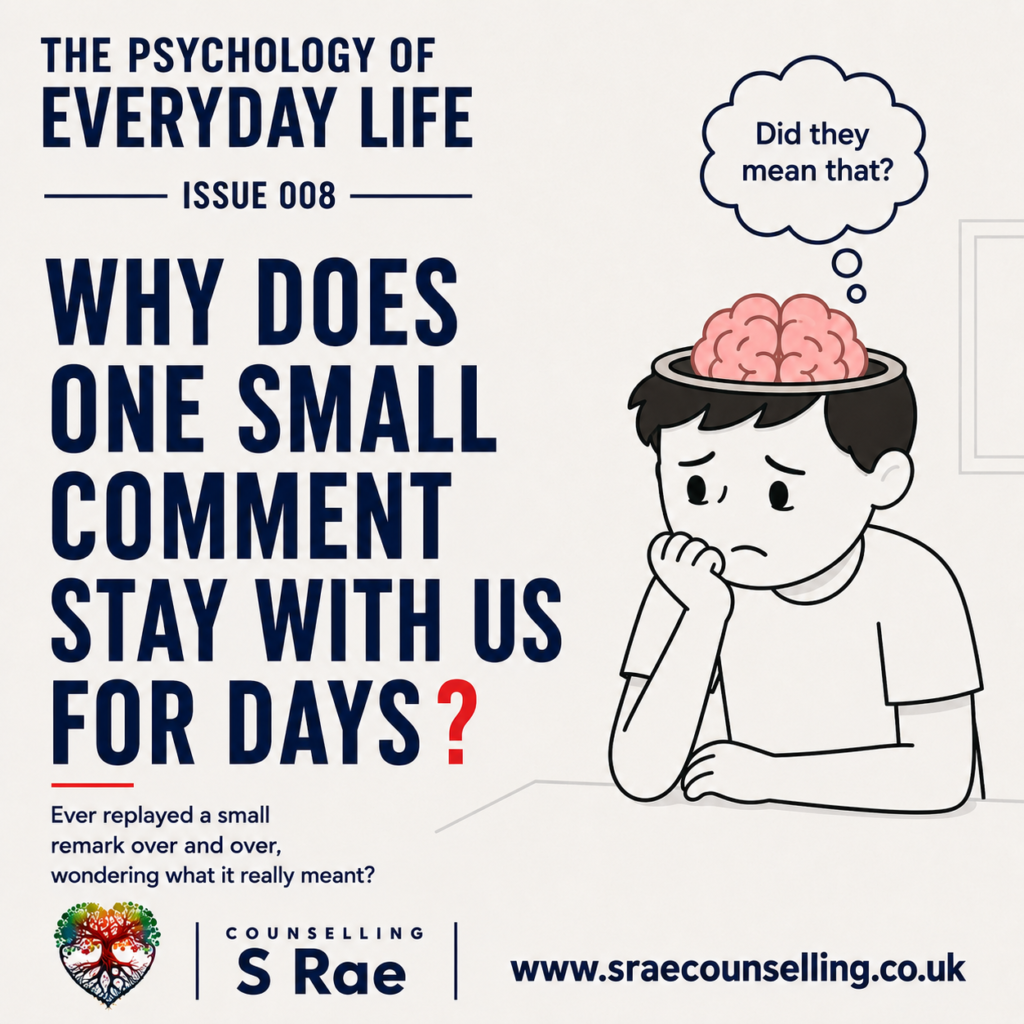
Understanding why certain words linger in our minds long after the conversation has ended
Why do some comments stay with us long after they have been spoken? Someone makes a brief remark about our appearance, personality, work or choices. The conversation moves on, but our mind does not.
Hours later, we are still replaying it:
“Did they really mean that?”
“Was it meant as a criticism?”
“Does everyone else think the same thing?”
“Why has it affected me so much?”
The other person may have forgotten the comment almost immediately, yet it can remain with us for days. This does not necessarily mean we are overly sensitive. A small remark can connect with an existing insecurity, create uncertainty or make us feel judged, rejected or misunderstood.
Understanding why this happens can help us decide whether the comment contains something useful—or whether our mind is giving it more power than it deserves.
Why do comments stay with us?
Our minds do not treat every experience equally.
Positive comments can feel pleasant, but critical or ambiguous remarks may demand more attention. The mind often focuses on possible threats, mistakes and signs of rejection because it is trying to protect us from being hurt again.
A comment that feels negative may therefore receive more mental attention than ten kind things said during the same day.
We might analyse:
- The exact words used
- The speaker’s facial expression
- Their tone of voice
- What they might have meant
- What we should have said in response
- Whether other people agree with them
The mind is attempting to understand the situation and prevent a similar experience in the future. Unfortunately, this search for certainty can become repetitive rather than helpful.
Negative words can feel more significant
Many people notice that criticism is easier to remember than praise.
Someone may receive several compliments about their work, but one small negative remark becomes the part they remember most clearly.
This can happen because negative information often feels more urgent. Praise may reassure us that everything is fine, while criticism suggests there may be a problem that needs to be understood or corrected.
Our mind may think:
“What if they are right?”
“What if I have missed something important?”
“What if other people have noticed this too?”
Even when the comment was careless, inaccurate or unhelpful, the possibility that it contains a difficult truth can keep us returning to it.
Comments stay with us when they touch an insecurity
A comment often hurts most when it connects with something we already worry about.
A casual remark about appearance may linger when someone already feels self-conscious about how they look.
A comment about being quiet may affect someone who worries that they are socially awkward.
A small correction at work may feel overwhelming to someone who already doubts their ability.
The words have not necessarily created the insecurity. They may have touched a belief that was already present.
This can make the comment feel like confirmation:
“I knew I wasn’t good enough.”
“They have noticed what I try to hide.”
“This proves what I already feared.”
When this happens, it can help to separate what the other person actually said from everything our existing insecurity has added to it.
Ambiguous comments leave room for interpretation
Clear communication is often easier to process than uncertainty.
If someone offers specific, respectful feedback, we can decide whether it is useful. But vague comments such as “That was interesting” or “You’re brave wearing that” can leave us unsure what was really meant.
The mind dislikes unanswered questions. When the meaning is unclear, we may try to solve it ourselves.
We replay the moment, looking for clues in the speaker’s tone, expression and behaviour. Because we cannot ask the past for more information, we may never reach a definite answer.
The uncertainty keeps the thought active.
Sometimes comments stay with us not because the words were especially severe, but because we cannot decide what they meant.
The person who said it can make a difference
The same comment can affect us differently depending on who says it.
A remark from a stranger may be easier to dismiss than the same words from a partner, parent, friend, colleague or someone whose opinion matters to us.
Comments can feel particularly powerful when they come from someone we:
- Respect or admire
- Depend upon emotionally
- Want approval from
- See as an authority
- Have previously experienced criticism from
- Expected to understand us
The comment may feel less like one person’s opinion and more like a judgement of who we are.
We may also be hurt because the remark came from someone we believed would be supportive. In that situation, the pain may be connected to disappointment or feeling misunderstood—not only to the words themselves.
Our emotional state also matters
A comment that would normally pass unnoticed may feel much more painful when we are already tired, stressed, anxious or emotionally vulnerable.
When our ability to cope is reduced, we may have less distance from what has been said.
A small remark can become the final thing in a difficult day. It may release feelings that have been building for much longer than the conversation itself.
This can leave us wondering why we reacted so strongly.
The reaction may not be about one comment alone. It may reflect several pressures arriving at the same time.
Rather than criticising yourself, it may help to ask:
“What else was I carrying when this was said?”
Why do we replay the conversation?
Replaying a conversation is often the mind’s attempt to gain control.
We imagine better responses:
“I should have challenged them.”
“I should have explained myself.”
“I should have said something clever.”
We may also mentally return to the situation because it felt unfinished. Perhaps we were surprised, froze in the moment or did not recognise how much the comment affected us until later.
Replaying can briefly create the feeling that we are solving the situation. However, when the same thoughts repeat without producing new understanding, reflection can become rumination.
Rumination keeps us emotionally connected to the moment while giving us very little that helps us move forward.
Are we treating an opinion as a fact?
A comment is not automatically an accurate description of us.
It may reflect:
- The other person’s mood
- Their personal preferences
- Their communication style
- Their limited understanding of the situation
- Their own insecurities
- A careless attempt at humour
- A misunderstanding
- An opinion rather than a fact
When comments stay with us, we can begin treating the speaker as though they have discovered something objectively true.
But one person’s reaction does not become a complete definition of our character, appearance, ability or worth.
Their words may contain useful information. They may also be inaccurate, insensitive or irrelevant.
We are allowed to consider the source before deciding how much importance the comment deserves.
Feedback and criticism are not the same
Constructive feedback is usually specific, respectful and intended to help.
It focuses on something that can be understood or changed:
“The presentation was clear, but adding an example might help explain the final point.”
Unhelpful criticism is often vague, personal or dismissive:
“You’re just not very good at this.”
The first offers information. The second may simply create shame.
When reviewing a comment, ask:
- Was it specific?
- Was it delivered respectfully?
- Did the person understand the full situation?
- Is there something useful I can take from it?
- Does it focus on one action, or does it attack who I am?
We do not have to accept harmful delivery in order to learn from useful information.
How to stop one comment controlling your day
We cannot always prevent words from hurting, but we can reduce the amount of authority we give them.
Write down exactly what was said
Try recording only the words you remember, without adding an interpretation.
Then write down what you believe the person meant.
This can reveal the difference between the comment and the story that developed around it.
Separate facts from assumptions
Ask yourself:
“What do I know, and what am I guessing?”
You may know that someone made a short remark. You may not know that everyone agrees with them or that they intended to hurt you.
Consider the source
Is this someone whose judgement you generally trust?
Do they know enough about you or the situation to offer a fair opinion?
Someone speaking confidently does not automatically make them correct.
Decide whether there is anything useful to keep
Even poorly delivered comments can occasionally contain information worth considering.
Take the part that helps you and leave the unnecessary judgement behind.
You do not need to repeatedly punish yourself in order to learn.
Offer yourself a balanced response
Replace an absolute thought such as:
“They are right. I always get things wrong.”
with something more realistic:
“They made one comment about one moment. It does not describe everything I do.”
A balanced thought does not pretend that nothing happened. It places the comment in proportion.
Speak to the person when appropriate
When the relationship matters and it feels safe to do so, clarification may prevent days of uncertainty.
You might say:
“I’ve been thinking about what you said earlier. What did you mean by it?”
“That comment stayed with me, and I wanted to check how you intended it.”
“I’m not sure you realised how that came across.”
The aim is not always confrontation. Sometimes it is simply gaining clarity or communicating a boundary.
Why self-compassion matters
We often respond to a painful comment by adding our own criticism.
We tell ourselves we should not care, should be tougher or should have handled the situation differently.
This creates a second layer of distress.
The original comment hurts, and then we judge ourselves for being hurt.
A kinder response might be:
“That touched something sensitive for me.”
“I was caught off guard.”
“It makes sense that I am still processing it.”
“I can feel affected without accepting the comment as true.”
Self-compassion does not make us weak. It can help the nervous system settle so we can evaluate what happened more clearly.
One comment does not define you
A person may form an opinion based on one conversation, one decision or one brief moment.
They do not see every experience that shaped you. They do not know every challenge you have faced, every kind thing you have done or every reason behind your choices.
Even when a comment points towards something worth reflecting on, it is still only one piece of information.
It is not your complete identity.
The next time a small remark keeps returning to your mind, ask:
“Is this helping me understand something—or am I continuing the criticism on the other person’s behalf?”
You can learn from an experience without carrying it indefinitely.
Counselling support
When criticism, fear of judgement or repetitive thoughts regularly affect your confidence, counselling can offer a safe place to explore why certain comments feel so powerful.
Understanding the beliefs and experiences beneath the reaction can help you develop greater self-trust, respond more compassionately and place other people’s opinions in perspective.
To arrange a free 30-minute consultation with S Rae Counselling:
📞 07895 843287
📧 sraecounselling@gmail.com
🌐 www.sraecounselling.co.uk