
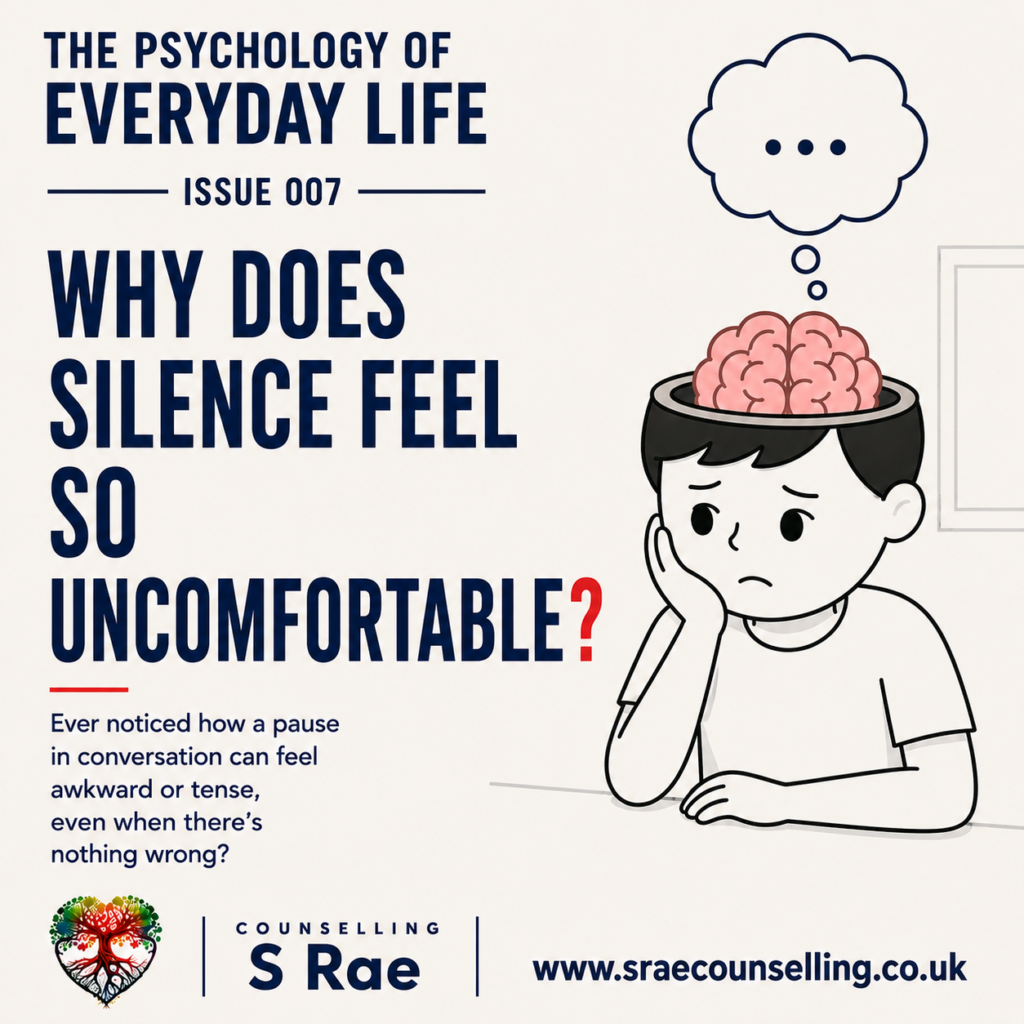
Understanding why quiet pauses can trigger self-consciousness, uncertainty and the urge to fill the space
Uncomfortable silence can make even a few quiet seconds feel much longer than they really are. A conversation pauses, nobody speaks and our mind immediately starts searching for an explanation.
“Have I said something wrong?”
“Are they bored?”
“Do they expect me to say something?”
“Is this becoming awkward?”
Although nothing negative may have happened, the absence of words can make us feel exposed or uncertain. We may rush to ask another question, change the subject, make a joke or say the first thing that enters our mind.
Silence itself is not always the problem. The discomfort often comes from the meaning we attach to it.
Why does uncomfortable silence affect us?
Conversation normally follows a rhythm. One person speaks, the other responds and the exchange continues with relatively short gaps between turns.
Research into everyday conversation suggests that turn-taking usually happens very quickly. Because we are so familiar with this pattern, even a brief interruption can feel noticeable.
A pause can create uncertainty about what is happening between us and the other person. We may wonder whether they disagree, have lost interest or are judging what we just said.
Experiments examining disrupted conversations found that even brief silences could reduce feelings of belonging and social validation while increasing negative emotions and perceived rejection. These effects could occur even when people were not consciously aware of the pause itself.
This helps explain why silence can feel emotionally significant even when we cannot identify exactly what is wrong.
Uncomfortable silence creates room for assumptions
When someone responds immediately, we receive reassurance that the conversation is continuing.
When they remain quiet, there is no clear information to interpret. Our mind may begin filling the gap itself.
We might assume:
“They didn’t like what I said.”
“I’ve embarrassed myself.”
“They think I’m boring.”
“They want to leave.”
“They’re waiting for me to fix this.”
These thoughts can feel convincing, but they are still assumptions.
The other person may simply be thinking, listening carefully, deciding how to respond or enjoying a moment that does not need to be filled.
A pause does not automatically mean rejection, disapproval or disconnection.
Why conversational flow feels reassuring
A smoothly flowing conversation can create a sense that we understand one another.
Studies have found that coordinated conversation can strengthen feelings of belonging and social connection, even independently of what is actually being discussed. When that flow is unexpectedly disrupted, we may briefly question whether the connection is still secure.
This does not mean every good conversation must be continuous.
It means that our minds can use the rhythm of an interaction as a social signal. A smooth exchange may feel like acceptance, while an unexpected pause can feel ambiguous.
That ambiguity is often what makes an uncomfortable silence difficult.
Silence feels different depending on the relationship
A quiet moment with a close friend may feel peaceful. The same pause with someone we have just met may feel tense.
Research comparing conversations between friends and strangers found that longer pauses were viewed as more awkward between strangers. Among friends, however, pauses could be experienced as opportunities to reflect and could even be associated with connection.
With someone familiar, we may trust that the relationship remains secure without constant conversation.
With a stranger, colleague or new acquaintance, we may have less information about what the pause means. We become more aware of how we are being perceived and may feel responsible for keeping the interaction moving.
This is why silence during a first meeting can feel very different from sitting quietly beside someone we know well.
Are we worried about being judged?
An uncomfortable silence can make us feel as though attention has suddenly turned towards us.
We may start monitoring ourselves:
“Was that a strange thing to say?”
“Should I have asked another question?”
“Do I look uncomfortable?”
“What are they thinking about me?”
The more closely we monitor ourselves, the harder it can become to speak naturally. We stop listening to the conversation and begin analysing our own performance.
This can create a cycle:
- The conversation pauses.
- We assume something is wrong.
- We become self-conscious.
- We feel pressure to speak.
- We say something only to remove the silence.
- We later replay and analyse what we said.
The original pause may have been harmless, but our interpretation turns it into a stressful experience.
Why do we feel responsible for filling the silence?
Some people automatically take responsibility for keeping conversations comfortable.
They may ask repeated questions, make jokes, change the subject or talk more than they intended because they do not want the other person to feel awkward.
This can be connected to people-pleasing or a fear of appearing unfriendly, boring or difficult.
We may believe:
“It’s my job to keep this going.”
“If they feel uncomfortable, I have failed.”
“I need to make sure they like me.”
“I should always know what to say.”
But conversation is shared. Both people contribute to its rhythm, and neither person is solely responsible for preventing every pause.
You are allowed to take a moment to think. The other person is allowed to do the same.
Not every silence means the same thing
Silence can communicate many different things.
It may mean someone is:
- Thinking carefully
- Listening and processing
- Feeling relaxed
- Unsure how to respond
- Experiencing an emotion
- Respecting what has just been said
- Giving another person space
- Simply comfortable without talking
There are also moments when silence does signal tension, avoidance or disagreement. The important point is that we cannot understand its meaning from the absence of words alone.
Context, body language, tone and the relationship all matter.
Instead of immediately assuming the worst, we can leave room for more than one explanation.
Can silence be helpful?
Silence can give us time to reflect rather than respond automatically.
It can allow an emotional statement to be heard properly. It can prevent us from interrupting, overexplaining or offering a solution before the other person is ready.
In counselling, a thoughtful pause may provide room for someone to recognise a feeling or find words for something difficult. However, silence is not automatically helpful simply because it occurs; its meaning depends on the context, timing and sense of safety within the interaction.
Healthy silence feels different from being ignored or deliberately shut out.
One offers space. The other may create distance.
How to manage uncomfortable silence
You do not need to force yourself to enjoy every quiet moment. The aim is to become less frightened of what the silence might mean.
Pause before filling the space
Take one slow breath before speaking. This creates a small gap between the discomfort and your reaction.
You may discover that the other person was already preparing to respond.
Separate facts from assumptions
Ask yourself:
“What do I actually know?”
You may know that the person has not spoken for several seconds. You may not know that they are bored, angry or judging you.
Notice the urge to perform
Are you about to speak because you genuinely have something to add—or because you feel responsible for removing the silence?
Both reactions are understandable, but noticing the difference can help you choose your response.
Use simple, honest language
When a pause does need addressing, you can say:
“I’m just thinking about that.”
“Take your time.”
“I’m not quite sure how to respond yet.”
“There’s no rush.”
“That’s given me something to think about.”
These responses acknowledge the moment without treating it as a failure.
Practise small moments of quiet
Allow a few extra seconds before answering a question. Sit quietly with someone you trust. Resist reaching immediately for your phone whenever nothing is happening.
Comfort with silence can develop gradually.
Uncomfortable silence does not mean you have failed
A successful conversation is not one in which every second is filled with words.
There will be pauses, moments of uncertainty and times when neither person knows exactly what to say. These moments do not automatically mean the connection has disappeared.
Sometimes silence reflects awkwardness.
Sometimes it reflects thoughtfulness.
Sometimes it reflects comfort.
And sometimes it is simply a pause.
Learning to tolerate an uncomfortable silence does not mean becoming emotionally detached. It means recognising that a quiet moment does not always require an explanation, an apology or an immediate solution.
Counselling support
When fear of judgement, social anxiety or pressure to keep other people comfortable affects your conversations and relationships, counselling can offer a supportive place to explore these patterns.
Understanding what makes silence feel threatening can help you develop greater self-trust, feel less responsible for other people’s reactions and communicate more naturally.
Book a free 30-minute consultation with S Rae Counselling:
📞 07895 843287
📧 sraecounselling@gmail.com
🌐 www.sraecounselling.co.uk