
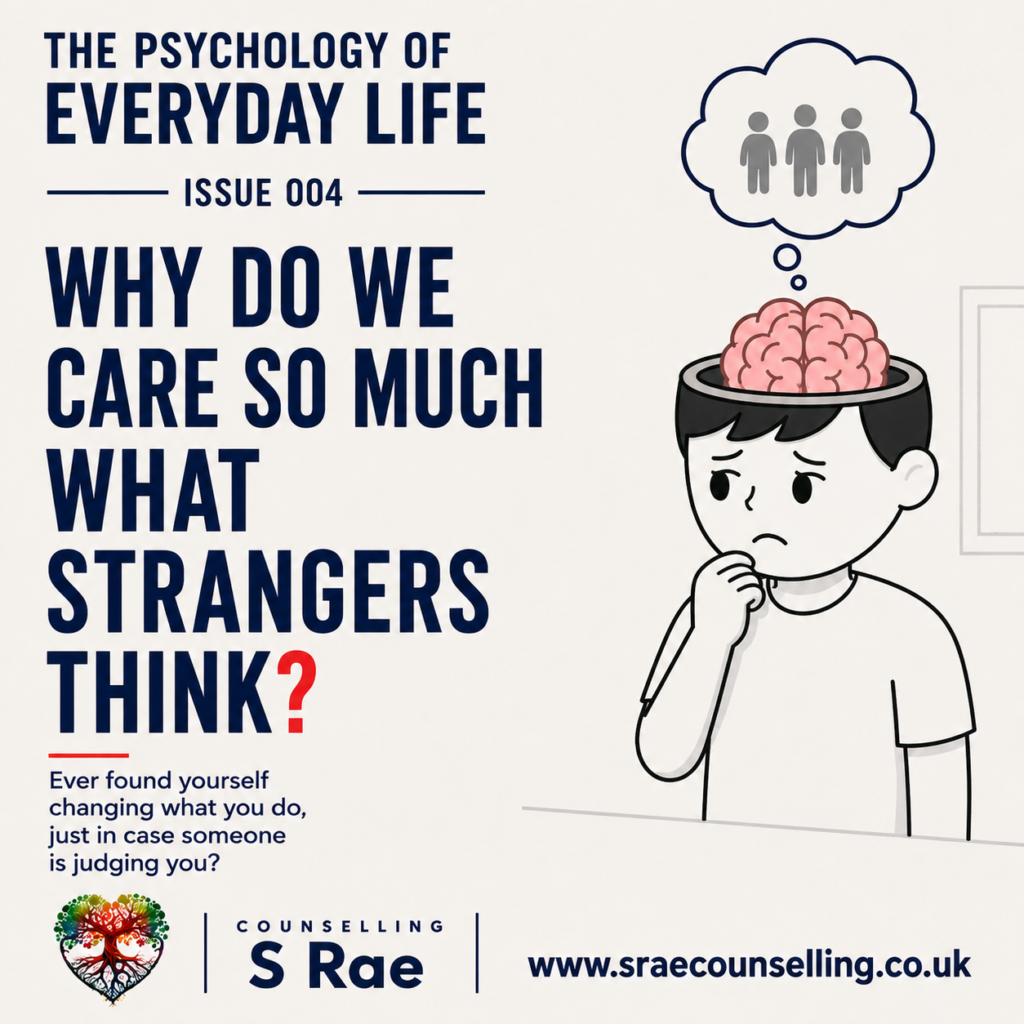
Why Do We Care So Much What Strangers Think?
A stranger glances in our direction. Someone nearby laughs just after we walk past. A person gives a short reply or looks at us with an expression we cannot quite understand.
Nothing has necessarily happened, yet our mind can immediately begin searching for an explanation.
“Did I do something wrong?”
“Do I look strange?”
“Were they talking about me?”
“Did I embarrass myself?”
Even when we know very little about the other person, their imagined opinion can affect how we feel about ourselves. A brief interaction may stay in our thoughts for hours, while we replay what happened and try to work out how we were perceived.
Why can the opinions of people we may never see again feel so important?
The answer often lies in our natural need for belonging, the way our minds respond to uncertainty and the experiences that have shaped how safe we feel around other people.
Our brains are sensitive to social acceptance
Human beings are social by nature. Throughout history, being part of a group offered protection, shared resources and support. Rejection or exclusion could place a person in a vulnerable position.
Although modern life is very different, our brains can still respond to social judgement as though it represents a threat.
We instinctively notice facial expressions, changes in tone of voice, body language and signs that someone might approve or disapprove of us. This awareness can help us navigate relationships and social situations, but it can also become overly sensitive.
A neutral look may feel like criticism. A delayed response may feel like rejection. Someone else’s bad mood may feel like evidence that we have done something wrong.
Our mind is often trying to protect us, but it does not always interpret the situation accurately.
Uncertainty encourages us to fill in the gaps
We cannot know exactly what another person is thinking. This uncertainty can feel uncomfortable, so the mind attempts to create an explanation.
Unfortunately, the explanation we choose is often the most critical one.
Someone looks away, and we assume they are avoiding us.
Someone does not smile back, and we decide they dislike us.
A group laughs nearby, and we wonder whether we are the joke.
This is sometimes described as “mind reading”—assuming we know what another person thinks without having enough evidence.
The story our mind creates may feel convincing, but a feeling is not always a fact. The person may be distracted, tired, anxious, preoccupied or thinking about something completely unrelated to us.
There are usually many possible explanations, but when we are already feeling self-conscious, the negative one can seem the most believable.
We often overestimate how much people notice us
Most of us naturally view situations from our own perspective. We are aware of every hesitation, mistake and insecurity because we experience them from the inside.
This can lead us to believe that other people are noticing us just as closely.
We may assume everyone saw us stumble over a word, walk into the wrong room or make a small mistake. In reality, other people are often focused on their own thoughts, worries and responsibilities.
They may be wondering how they are being perceived too.
This tendency to overestimate how much attention other people pay to us is sometimes called the “spotlight effect.” It can feel as though a spotlight is shining on everything we do, even though most people are not watching nearly as closely as we imagine.
What feels enormous to us may barely register with someone else.
Past experiences can make judgement feel more threatening
Our response to other people’s opinions is also shaped by what we have experienced before.
Someone who has been criticised frequently, bullied, excluded or embarrassed may become especially alert to signs of judgement. They may have learned to monitor how they speak, behave or present themselves in order to avoid further criticism.
Growing up in an environment where approval depended on being helpful, successful, quiet or well-behaved can also influence this.
A person may begin to believe:
“I need everyone to like me.”
“I must not make mistakes.”
“I have to behave in the right way.”
“If someone disapproves of me, I have failed.”
These beliefs can continue long after the original situation has passed. Even the reaction of a stranger can activate the fear of being rejected or found inadequate.
This does not mean someone is weak or overly sensitive. It may mean their mind has learned to stay alert as a form of protection.
Self-esteem influences how we interpret other people
When we already feel uncertain about ourselves, the reactions of others can seem like confirmation of our worst fears.
A person who worries about their appearance may interpret a glance as criticism.
Someone who doubts their abilities may see a small correction as proof that they are incompetent.
A person who feels socially anxious may assume that silence means they are boring or unlikeable.
The stranger has not necessarily created the insecurity. Their reaction has simply touched something that was already painful.
When our self-worth depends heavily on external approval, even small signs of possible rejection can feel powerful. We may change our choices, hide parts of ourselves or avoid situations where we could be judged.
Social media can intensify the fear of judgement
Social media has made other people’s opinions more visible than ever.
Likes, comments, views and follower numbers can create the impression that our value is constantly being measured. We may compare our ordinary lives with carefully selected moments from someone else’s.
Over time, we can become more conscious of how we appear from the outside.
Instead of asking, “Did I enjoy this?” we may ask, “How will this look?”
Instead of thinking, “Do I like this?” we may wonder, “Will other people approve?”
This can slowly move us away from our own values and towards a life shaped by imagined expectations.
Caring what others think is not always negative
It is important to remember that caring about other people’s opinions is not automatically a problem.
Being aware of how our behaviour affects others helps us develop empathy, maintain relationships and recognise when we need to take responsibility.
The difficulty begins when fear of judgement controls our decisions.
We may stay quiet when we want to speak.
We may avoid wearing something we like.
We may agree to things we do not want to do.
We may hide our interests, personality or emotions.
We may spend hours analysing a brief interaction.
The aim is not to stop caring about people altogether. It is to develop a healthier balance between considering others and trusting ourselves.
How can we respond differently?
When you notice yourself worrying about what someone thinks, pause before accepting the thought as true.
Ask yourself:
What do I actually know?
Separate the facts from the assumptions. You may know that someone looked in your direction. You may not know why.
Are there other possible explanations?
Try to think of two or three neutral alternatives. Perhaps they were distracted, recognised someone behind you or were simply lost in thought.
Will this matter in a week?
A moment that feels significant now may soon become completely unimportant.
Am I judging myself on someone else’s behalf?
Sometimes we imagine criticism and then punish ourselves for something the other person may never have thought.
What choice would feel right if nobody were watching?
This can help reconnect you with your own preferences and values.
It can also help to practise allowing small amounts of discomfort. Wear the outfit you like. Share an opinion respectfully. Try something new without waiting for everyone’s approval.
Confidence often develops when we discover that we can survive being misunderstood, disagreed with or briefly judged.
Your value is bigger than a passing opinion
A stranger sees only a tiny moment of your life.
They do not know what you have experienced, what matters to you, what you have overcome or the intentions behind your choices. Their impression—whether real or imagined—is not a complete picture of who you are.
You may never be able to control what every person thinks about you. Trying to do so can become exhausting and can gradually disconnect you from yourself.
What you can develop is the ability to notice the fear of judgement without automatically allowing it to lead.
Caring what others think is human. But your life does not have to be organised around the opinions of people who do not truly know you.
Counselling can help
When fear of judgement affects your relationships, confidence or everyday choices, counselling can provide a safe place to explore where those fears began.
Understanding the experiences and beliefs behind the reaction can make it easier to develop greater self-trust, stronger boundaries and a more compassionate relationship with yourself.
To arrange a free 30-minute consultation with S Rae Counselling:
📞 07895 843287
📧 sraecounselling@gmail.com
🌐 www.sraecounselling.co.uk