Understanding uncertainty, emotional safety and why familiar situations can be hard to leave
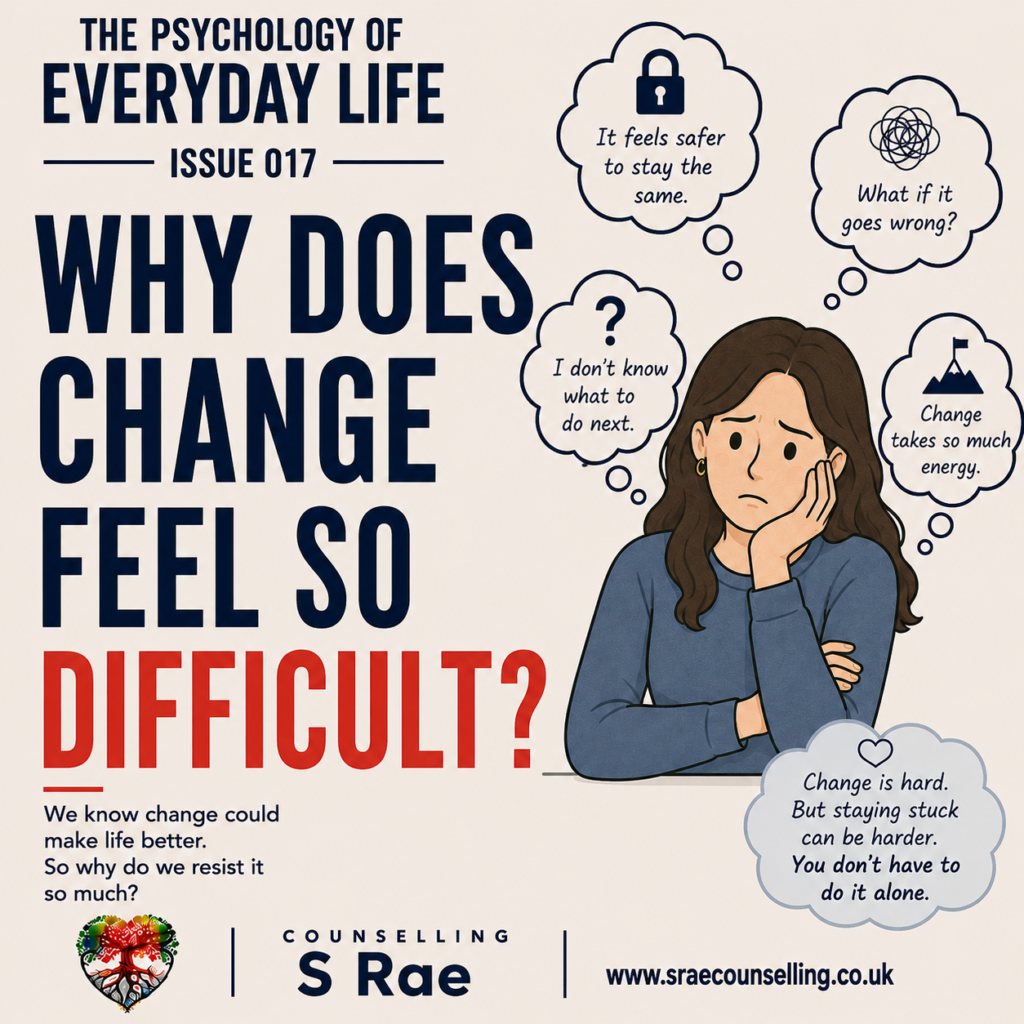
Why does change feel difficult, even when we believe it could improve our lives?
We may want to leave an unhappy situation, establish a healthier routine, begin a new relationship, change careers or set a long-overdue boundary. Part of us understands why the change is necessary.
Yet another part quietly resists.
We delay making the decision. We imagine everything that could go wrong. We return to familiar habits or convince ourselves that now is not the right time.
Our thoughts may sound like:
“What if I regret it?”
“What if I cannot cope?”
“What if the new situation is worse?”
“What if I lose what I already have?”
This resistance does not necessarily mean that the change is wrong. It may mean that the unfamiliar feels uncertain, demanding or emotionally unsafe.
Even positive and expected changes can create stress because they require adjustment and introduce uncertainty. NHS guidance recognises that major life changes—and even changes we welcome—can temporarily affect our mental wellbeing.
Why Does Change Feel Difficult?
Change asks the mind to move away from what it already understands.
Our current circumstances may be uncomfortable, but they are familiar. We know what to expect, which problems are likely to appear and how we usually respond.
A new situation removes some of that predictability.
We may need to:
- Learn unfamiliar routines
- Make new decisions
- tolerate mistakes
- meet different people
- lose an existing role or identity
- trust ourselves without knowing the outcome
- use more emotional and practical energy
The mind often prefers a known difficulty to an unknown possibility because familiarity can feel safer than uncertainty.
This does not mean we consciously want to remain stuck. It means predictability can feel reassuring, even when what we are predicting is unpleasant.
Uncertainty Can Feel Like a Threat
Change always contains something we cannot know in advance.
We can plan carefully, gather information and prepare—but we cannot guarantee how the future will unfold.
For some people, this uncertainty creates strong anxiety.
They may repeatedly ask:
“What if something goes wrong?”
“How will I know I made the right choice?”
“What if I cannot reverse the decision?”
“What if I am not prepared?”
Psychologists sometimes use the term intolerance of uncertainty to describe difficulty managing situations in which the outcome is unclear. Research has linked greater intolerance of uncertainty with worry and several forms of emotional distress.
The mind may attempt to reduce uncertainty through overthinking, repeated checking, avoidance or delaying a decision.
Unfortunately, these strategies rarely create complete certainty. They often keep us focused on every possible danger.
Familiar Does Not Always Mean Safe
We sometimes confuse familiarity with safety.
A difficult relationship, unhelpful habit or stressful environment may feel emotionally familiar because we have adapted to it. We know the rules and have developed ways to cope.
Leaving means entering a situation where those familiar coping strategies may no longer apply.
We might think:
“At least I know what I’m dealing with here.”
“I’ve managed this long.”
“Perhaps it’s not bad enough to change.”
This can make remaining in a painful situation feel less frightening than stepping into the unknown.
But familiar discomfort is still discomfort.
Recognising this does not mean we should make sudden decisions. It means asking whether familiarity is genuinely protecting us—or simply keeping us in a pattern we already understand.
Change Can Involve Loss
Even when change brings something positive, it may also require us to leave something behind.
Beginning a new job can mean losing familiar colleagues and routines.
Moving home may involve gaining a better environment while grieving the memories connected to the old one.
Setting a boundary may protect our wellbeing but change how a relationship functions.
Recovering emotionally may mean letting go of an identity built around survival.
We can feel hopeful and sad at the same time.
Mixed emotions do not mean we have chosen incorrectly. They may reflect the reality that meaningful change often includes both gain and loss.
We May Fear Making the Wrong Decision
Change can feel particularly difficult when we believe there is one perfect decision and serious consequences for choosing incorrectly.
We may try to predict every outcome before taking action.
This can lead to:
- Repeatedly asking other people what they would do
- Creating endless lists of advantages and disadvantages
- Searching for more information after we already have enough
- Delaying until circumstances force a decision
- Replaying previous choices
- Waiting to feel completely certain
But many important decisions do not come with complete certainty.
Sometimes we make the best decision available using the information, values and capacity we have at the time.
A decision can be thoughtful without being guaranteed.
Past Experiences Can Make Change Feel Unsafe
Our response to change is influenced by what change has represented before.
If earlier changes involved loss, conflict, instability, rejection or disappointment, the nervous system may become alert whenever something begins to shift.
A new opportunity may trigger an old fear:
“Last time things changed, I got hurt.”
Someone who experienced unpredictable childhood circumstances may have learned to depend heavily on routines and control. Another person may fear change because previous attempts to improve their situation were criticised or undermined.
These reactions are not overreactions when viewed within the person’s history.
The mind may be applying an old protective lesson to a new situation.
Change Requires Energy
Change can be demanding even when we feel excited about it.
We may need to think more carefully, remember new information and make decisions that previously happened automatically.
A familiar routine uses less mental energy because the brain knows what comes next.
A new routine requires attention.
This is one reason change can feel especially difficult when we are already:
- Exhausted
- Grieving
- Anxious
- Caring for other people
- Experiencing poor health
- Managing financial pressure
- Facing several changes at once
Resistance may not mean we lack motivation. It may mean our emotional and practical capacity is already stretched.
Rather than asking, “Why can’t I just do this?” it may help to ask:
“What support, time or structure would make this change more manageable?”
We May Be Afraid of Losing Our Identity
Some changes challenge how we understand ourselves.
Leaving a long-term role may make us wonder who we are without it.
Receiving help may conflict with the identity of being independent.
Resting may feel uncomfortable when we have always seen ourselves as productive.
Setting boundaries may feel wrong when we are known as the person who always helps.
The change may be practical, but the fear underneath it is personal:
“Who will I become?”
“What will people expect from me?”
“Will I still belong?”
Identity changes can take time. We do not need to have a fully formed new version of ourselves before taking the first step.
Other People May Prefer Us Not to Change
Change does not happen in isolation.
When we alter our behaviour, the people around us may also need to adjust.
If we stop saying yes automatically, someone may lose easy access to our time.
If we become more confident, a relationship built around our self-doubt may begin to feel different.
If we seek a new opportunity, others may fear being left behind.
This does not mean they are deliberately trying to prevent our growth. They may also be responding to uncertainty.
But another person’s discomfort is not always evidence that our change is wrong.
Sometimes it means the existing pattern benefited them.
Why Motivation Often Disappears
We may begin a change feeling motivated and hopeful.
Then, when the process becomes repetitive, difficult or slow, enthusiasm fades.
This can feel like proof that we were never committed.
But motivation naturally changes. It is influenced by sleep, stress, mood, support and whether we can see immediate progress.
Long-term change usually depends less on feeling constantly inspired and more on having:
- Realistic expectations
- Repeatable routines
- Supportive people
- Small achievable steps
- A reason that matters personally
- Compassion when progress is uneven
Waiting until we feel motivated every day can keep us trapped in repeated restarts.
Change Can Challenge Our Need for Control
Uncertainty can create the feeling that events are happening to us rather than being guided by us.
We may try to regain control by planning every detail.
Planning can be useful, but complete control is not possible.
NHS guidance on managing change recommends focusing on what is within our control, maintaining helpful routines and accepting that uncertainty is part of changing circumstances.
A useful distinction is:
What can I influence?
and:
What must I learn to tolerate?
We may control whether we ask for support, gather information or take one small action.
We cannot completely control how every person reacts or whether the process unfolds exactly as expected.
Avoidance Brings Short-Term Relief
When we postpone a change, anxiety may fall temporarily.
We tell ourselves:
“I don’t need to decide today.”
“I’ll start next week.”
“Maybe things will improve on their own.”
The immediate relief makes avoidance feel helpful.
But it can also teach the mind:
“I escaped the decision, so the change must have been dangerous.”
The next attempt may feel even harder.
Avoidance is not laziness. It is often an attempt to reduce distress.
The difficulty is that short-term relief can maintain long-term fear.
How Can We Make Change Feel More Manageable?
The goal is not to remove all uncertainty.
It is to make the next step small enough that we can move forward while uncertainty is still present.
Name What You Are Afraid Of
Instead of thinking, “Change is frightening,” try becoming more specific.
Are you afraid of:
- Failure?
- Regret?
- Conflict?
- Losing stability?
- Being judged?
- Not coping?
- Disappointing someone?
- Beginning again?
A specific fear is easier to understand than a general sense of dread.
Separate Possibility From Probability
An outcome being possible does not mean it is likely.
Ask:
“What evidence supports this fear?”
“What evidence suggests I may cope better than I expect?”
“What is the most realistic outcome—not only the worst one?”
This does not guarantee success. It helps place fear in proportion.
Break the Change Into Smaller Steps
A major change can feel impossible when viewed as one enormous task.
Instead of “change careers,” the first step might be researching one course.
Instead of “fix the relationship,” it might be arranging one honest conversation.
Instead of “become healthier,” it might be taking a short walk twice this week.
Smaller steps give the mind evidence that movement is possible.
Keep Something Familiar
Change can feel safer when not everything shifts at once.
Maintain a familiar morning routine, regular contact with a trusted person or an activity that helps you feel grounded.
Stability and change can exist together.
Make Room for Mixed Feelings
You do not need to feel completely confident or excited.
You can feel:
- Hopeful and frightened
- Ready and uncertain
- Relieved and sad
- Motivated and tired
Emotional conflict does not necessarily mean stop. It may mean the change matters.
Focus on Values Rather Than Fear
Ask:
“What kind of life am I trying to move towards?”
“What matters enough to make this discomfort worthwhile?”
Values can provide direction when confidence is inconsistent.
You may not feel brave, but you can take an action aligned with honesty, wellbeing, connection or independence.
Plan for Difficult Moments
Change becomes easier when we expect that motivation and confidence will fluctuate.
Consider:
“What will I do when I want to give up?”
“Who can I contact?”
“What reminder will help me reconnect with my reason?”
“What is the smallest version of the action I can still complete?”
A difficult day does not erase previous progress.
Confidence Often Comes After Action
We may believe we must feel ready before we begin.
But readiness is not always a feeling that arrives first.
Sometimes confidence develops because we take a small step, survive the discomfort and discover that we can respond to what happens.
The order may be:
- Feel uncertain.
- Take a manageable action.
- Learn from the experience.
- Develop more trust in yourself.
Courage does not mean having no fear.
It may mean allowing fear to come with you without giving it complete control.
Change Does Not Need to Be Dramatic
We often imagine change as one decisive moment.
In reality, meaningful change may involve many small choices repeated over time.
It may look like:
- Pausing before automatically saying yes
- Speaking more honestly
- Asking for help sooner
- Leaving one situation ten minutes earlier
- Resting without apologising
- Trying again after a setback
- Responding differently once
Small actions may not feel significant, but repetition gradually creates a different pattern.
When Change Is Not Entirely Our Choice
Some changes are chosen. Others happen to us.
Bereavement, illness, redundancy, relationship endings and changes in family circumstances may remove the sense of control completely.
In these situations, the task is not necessarily to “embrace change.”
It may be to process what has happened, adjust gradually and find support while life feels unfamiliar.
There is no correct speed for adapting.
NHS guidance recognises that life changes can bring a wide range of emotions and that professional support may be helpful when stress or anxiety begins affecting daily life.
You Are Not Failing Because Change Feels Hard
Change can challenge our sense of safety, identity and control.
It asks us to leave a familiar position before we fully understand the new one.
Feeling anxious does not mean you are incapable.
Missing what you left does not mean you should return.
Needing support does not mean you are not ready.
You may simply be adjusting to something unfamiliar.
Instead of asking:
“Why am I finding this so difficult?”
try:
“What would help me feel supported while I move through it?”
Counselling Support
When change leaves you feeling stuck, anxious or uncertain, counselling can offer a safe place to understand what is making the transition feel threatening.
Together, we can explore the fears, previous experiences and beliefs influencing your response—while identifying manageable steps that fit your pace and circumstances.
Book Your FREE 30-Minute Consultation
Take the first step towards better mental health with a free, no-obligation 30-minute consultation. We’re here to listen and support you.
📞 Call: 07895 843287
📧 Email: sraecounselling@gmail.com
🌐 Visit: sraecounselling.co.uk
Let’s talk—your wellbeing matters. 💙