
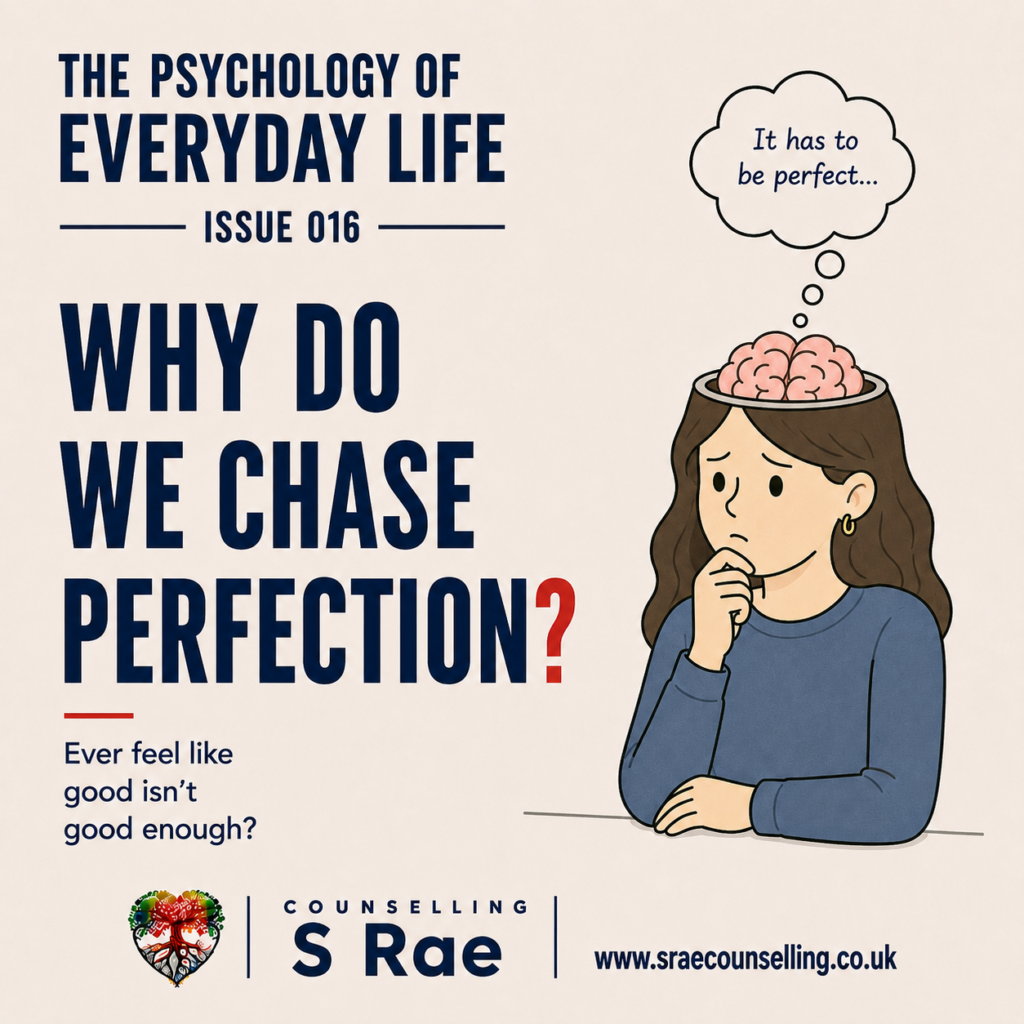
Understanding why “good enough” can feel unsafe—and why perfect never seems to arrive
Why do we chase perfection, even when the pressure leaves us anxious, exhausted and unable to enjoy what we have achieved?
We may spend hours improving something that was already good. We avoid beginning because we fear doing it badly. We replay small mistakes, dismiss compliments and raise our standards every time we reach them.
The thought may sound like:
“It has to be perfect.”
“I cannot afford to get this wrong.”
“People will notice every mistake.”
“If I do well enough, I’ll finally feel confident.”
Perfectionism can look like determination, organisation or ambition. Those qualities are not inherently unhealthy. The difficulty begins when our self-worth becomes dependent on meeting standards that are unrealistic, rigid or impossible to maintain.
We are no longer simply trying to do something well. We are trying to protect ourselves from criticism, rejection, shame or the fear that we are not good enough.
What Does It Mean to Chase Perfection?
Chasing perfection does not always mean believing we can literally become flawless.
It may mean feeling that:
- Mistakes are unacceptable
- Rest must be earned
- Success only counts when it is exceptional
- Other people must always be pleased
- Asking for help shows weakness
- Anything less than the best is failure
- We should always be productive
- Our appearance, relationships or home must look right
These standards can affect work, education, parenting, relationships, appearance and everyday decisions.
Some people delay submitting work because it never feels finished. Others repeatedly check messages before sending them, avoid unfamiliar activities or become distressed when plans change.
The behaviour may differ, but the underlying fear is often similar:
“What will this say about me if I do not get it right?”
Perfectionism Is Often About Protection
Perfectionism is sometimes misunderstood as simply wanting high standards.
But many perfectionistic patterns are driven by fear.
We may believe that perfect performance will protect us from:
- Criticism
- Rejection
- Embarrassment
- Conflict
- Disappointment
- Feeling inferior
- Losing control
- Being seen as incapable
The mind creates a rule:
“If I do everything properly, nothing bad will happen.”
This can provide a temporary sense of control. Unfortunately, life contains uncertainty, mistakes and other people’s unpredictable reactions. No amount of preparation can remove every risk.
The harder we try to create certainty through perfection, the more anxious we may become when reality refuses to follow the plan.
We May Have Learned That Achievement Brings Approval
Some people grow up feeling most noticed when they perform well.
They may receive praise for high marks, good behaviour, responsibility or achievement, while their emotional needs receive less attention.
They can begin to believe:
“I am valued when I succeed.”
“I must make people proud.”
“Mistakes disappoint others.”
“My best is only enough when it is better than everyone else’s.”
This does not mean their family deliberately created perfectionism. Expectations can be communicated subtly through praise, comparison, criticism or repeated emphasis on results.
Over time, achievement may become closely connected to identity.
Doing something imperfectly no longer feels like one disappointing result. It can feel like becoming a disappointing person.
Fear of Criticism Can Keep the Cycle Going
When criticism feels threatening, perfectionism may become a way of trying to prevent it.
We check, rehearse, plan and overprepare because we want to remove every possible weakness before someone else can see it.
This may bring short-term relief:
“I’ve checked it again, so perhaps it will be safe.”
But the relief teaches the mind that repeated checking was necessary. The next time, we feel compelled to do even more.
The standard gradually rises.
What was once considered excellent begins to feel ordinary. What once felt good enough now feels careless.
Perfectionism promises reassurance, but rarely provides it for long.
Mistakes Can Feel Like Personal Failure
A mistake is something that happened.
Perfectionism can turn it into a judgement about who we are.
Instead of thinking:
“I made an error,”
we may think:
“I am incompetent.”
Instead of:
“This conversation did not go as planned,”
we conclude:
“I always ruin things.”
The mind moves from one event to a global judgement.
This is painful because mistakes become evidence in a case against ourselves. We stop viewing them as information and begin treating them as exposure.
But a mistake does not reveal your entire character. It reflects one decision, one moment or one area where something did not work.
You can take responsibility without turning the experience into a verdict on your worth.
Why Success Never Feels Like Enough
Perfectionism can make success surprisingly difficult to enjoy.
When we achieve something, we may immediately think:
“It should have been better.”
“I was lucky.”
“Anyone could have done that.”
“What do I need to achieve next?”
The goal moves before we have had time to recognise reaching it.
This can create a life filled with accomplishments but very little satisfaction.
The problem is not necessarily a lack of success. It is that success has been given an impossible job: proving permanently that we are good enough.
No achievement can provide lasting reassurance when the underlying belief remains:
“My worth depends on what I produce.”
Perfectionism Can Lead to Procrastination
Perfectionism and procrastination may appear to be opposites.
One looks highly driven. The other looks avoidant.
In reality, they can be closely connected.
When the standard feels impossible, beginning becomes frightening. We may delay because we do not know how to create the perfect result.
We tell ourselves:
“I need to feel more prepared.”
“I’ll start when I have enough time.”
“I need the right idea first.”
Avoidance temporarily protects us from discovering that our work may be imperfect. But as the deadline approaches, anxiety rises and we may rush, withdraw or abandon the task completely.
The person is not necessarily lazy. They may be overwhelmed by what beginning appears to demand.
Perfectionism Can Affect Relationships
Perfectionism does not only affect performance.
We may try to be the perfect partner, friend, parent or colleague.
This can mean:
- Never expressing difficult feelings
- Avoiding asking for support
- Taking responsibility for everyone’s comfort
- Hiding mistakes
- Overexplaining decisions
- Expecting ourselves always to respond calmly
- Believing conflict means the relationship is failing
We may also hold other people to rigid standards because uncertainty feels difficult.
When relationships do not match the ideal in our mind, we may feel disappointed, anxious or critical.
Healthy relationships are not flawless. They involve misunderstanding, repair, compromise, changing needs and imperfect people learning how to communicate.
Social Media Can Strengthen Unrealistic Standards
Online, we are surrounded by finished results.
We see the renovated room, successful business, organised family, confident body and carefully presented relationship.
We rarely see the mistakes, help, money, time, conflict or uncertainty behind them.
Repeated exposure can make exceptional presentation feel ordinary.
We may begin expecting ourselves to maintain standards that were created for a photograph, advertisement or carefully selected moment.
The comparison becomes unfair:
We compare our unedited life with someone else’s chosen display.
It can help to remember that visible perfection is not evidence of an effortless life.
Healthy High Standards Are Different
Wanting to do something well is not a problem.
Healthy ambition can encourage effort, learning and pride.
The difference often lies in flexibility and self-worth.
Healthy high standards say:
“I would like to do this well.”
Perfectionism says:
“I must do this perfectly, or it proves something is wrong with me.”
Healthy ambition allows:
- Learning
- Feedback
- Rest
- Mistakes
- Changing priorities
- Asking for help
- Celebrating progress
Perfectionism treats these things as threats.
A useful question is:
“Does this standard support me—or punish me?”
What Is Perfectionism Costing You?
Perfectionism often appears useful because it may produce careful work or visible achievement.
But it can also carry a significant cost.
You may notice:
- Constant overthinking
- Difficulty completing tasks
- Fear of trying something new
- Exhaustion
- Procrastination
- Harsh self-criticism
- Difficulty accepting compliments
- Avoiding feedback
- Feeling unable to rest
- Never feeling satisfied
- Resentment towards other people
- Loss of enjoyment
A standard is not truly helping when maintaining it requires sacrificing your wellbeing.
How Can We Loosen Perfectionism?
The aim is not to stop caring or deliberately perform poorly.
It is to develop standards that are realistic, flexible and proportionate to what the situation requires.
Define “Good Enough” Before You Begin
Perfectionism often keeps changing the finish line.
Before starting, decide what completion will look like.
Ask:
- What is the purpose of this task?
- How much time does it reasonably deserve?
- What standard is actually required?
- What would be acceptable rather than flawless?
A routine email does not require the same attention as an important legal document. Not every task deserves maximum effort.
Use a Time Limit
Decide how long you will spend and stop when that time ends.
This can feel uncomfortable, but it helps challenge the belief that more effort will always produce enough reassurance.
Practise Small Imperfections
Allow a low-risk task to remain slightly imperfect.
Send a message after checking it once. Leave a minor household task until tomorrow. Try something new without expecting immediate competence.
The purpose is not carelessness. It is teaching your mind that imperfection can be tolerated.
Replace Judgement With Information
Instead of asking:
“What is wrong with me?”
try:
“What can I learn from this?”
A mistake can provide useful information without becoming an attack on your identity.
Notice the Moving Goalpost
When you succeed, pause before creating the next demand.
Write down what went well. Allow yourself to acknowledge the effort and progress involved.
You do not need to minimise an achievement to remain humble.
Speak to Yourself as You Would to Someone Else
Consider how you would respond to a friend who made the same mistake.
You might say:
“You were under pressure.”
“One mistake does not erase everything you did well.”
“You can correct it.”
“You are still learning.”
You deserve the same fairness.
Self-Compassion Is Not Lowering Your Standards
Some people fear that being kinder to themselves will remove motivation.
They believe self-criticism is what keeps them productive.
But criticism often creates anxiety, avoidance and exhaustion. It may force short-term action while making the process painful.
Self-compassion does not mean pretending that mistakes do not matter. It means responding to them without humiliation.
You can say:
“That did not go as planned.”
“I need to take responsibility.”
“I can try a different approach.”
without adding:
“I am worthless.”
Accountability and kindness can exist together.
Progress Is Often Quiet
Perfectionism tends to recognise only dramatic results.
But meaningful progress may look like:
- Starting before you feel fully ready
- Submitting something that is good enough
- Asking for help
- Recovering more quickly from a mistake
- Resting without earning it
- Trying again
- Setting a realistic boundary
- Speaking to yourself less harshly
These changes may not look impressive from the outside, but they can transform how life feels.
You Do Not Have to Earn Your Worth
Perfectionism often rests on the belief that worth is conditional.
It tells us that we will deserve rest, confidence, love or acceptance once we have performed well enough.
But there will always be another standard available.
Your value cannot safely depend on flawless achievement because no human being can maintain it.
You are allowed to be learning.
You are allowed to be unfinished.
You are allowed to make mistakes and remain worthy of care.
Counselling Support
When perfectionism affects your confidence, relationships, work or ability to rest, counselling can provide a safe place to explore where those expectations began.
Understanding the fear beneath the standards can help you develop a kinder and more flexible relationship with yourself—without abandoning the things that genuinely matter to you.
Book Your FREE 30-Minute Consultation
Take the first step towards better mental health with a free, no-obligation 30-minute consultation. We’re here to listen and support you.
📞 Call: 07895 843287
📧 Email: sraecounselling@gmail.com
🌐 Visit: sraecounselling.co.uk
Let’s talk—your wellbeing matters.