
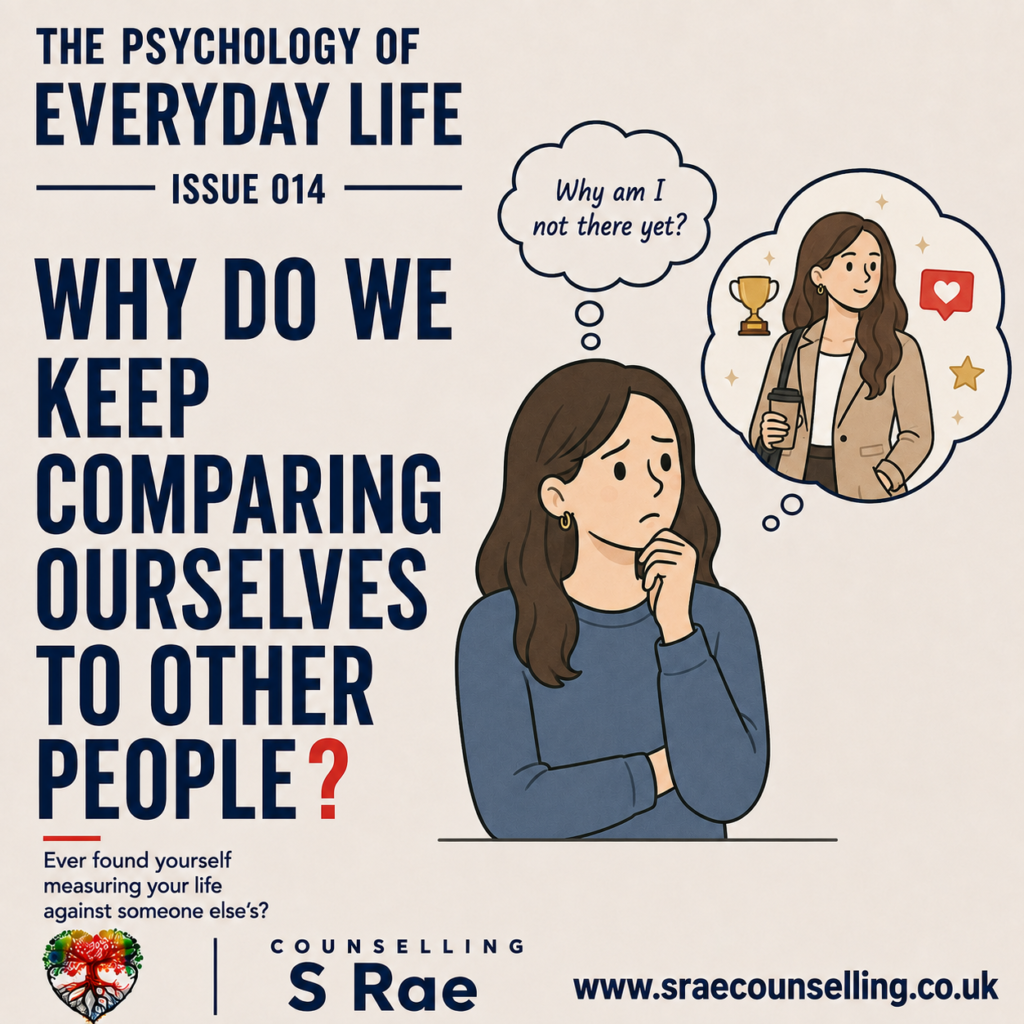
Understanding why we measure our lives against others—and how to make comparison less damaging
Why do we compare ourselves to others, even when we know it often leaves us feeling inadequate?
We notice someone’s appearance, career, relationship, confidence or achievements. Within moments, our mind begins measuring their life against ours:
“They’re doing better than me.”
“I should be further ahead.”
“Why does everything seem easier for them?”
“What am I doing wrong?”
Comparison can happen automatically. We may not consciously decide to assess ourselves against another person; our mind simply begins searching for similarities, differences and signs of where we stand.
This does not mean we are jealous, shallow or ungrateful. Comparing ourselves with other people is a common way of trying to understand our abilities, progress and place within the world. Social-comparison research suggests that people often use others as reference points when evaluating themselves, particularly when there is no clear objective measure available.
The difficulty begins when comparison stops providing useful information and starts becoming a repeated judgement of our worth.
Why Do We Compare Ourselves to Others?
We often understand things through contrast.
We know whether something feels warm by comparing it with something colder. In a similar way, we may evaluate our own progress by noticing what other people are doing.
We might compare:
- Our income with a colleague’s
- Our appearance with someone online
- Our relationship with another couple’s
- Our parenting with another family’s
- Our home with a neighbour’s
- Our progress with someone of a similar age
- Our confidence with someone who appears socially comfortable
Comparison can help answer questions such as:
“Am I doing reasonably well?”
“Is this normal?”
“What might be possible for me?”
“What do people in a similar situation usually do?”
The mind is often searching for information rather than deliberately trying to make us feel bad.
We Compare Most With People Who Feel Relevant
We do not usually compare ourselves equally with everyone.
We may be less affected by a highly successful person whose life feels completely different from ours. But someone of a similar age, background, occupation or friendship group can feel like a much more powerful comparison.
Their progress may seem to say something about what we should have achieved.
We may think:
“They started at the same time as me.”
“We went to the same school.”
“We are the same age.”
“If they managed it, why haven’t I?”
People who appear similar to us can feel like meaningful reference points, which is one reason their achievements may affect us more strongly. Research into social comparison has long examined how similarity influences whom people choose as comparison targets.
However, apparent similarity does not mean identical circumstances.
Two people of the same age may have completely different health, responsibilities, opportunities, finances, support systems and life experiences.
Upward Comparison: Looking at People Who Seem Ahead
An upward comparison happens when we compare ourselves with someone we believe is doing better.
This can sometimes be motivating.
Seeing another person achieve something may help us believe that change is possible. Their example may provide ideas, encouragement or direction.
But upward comparison can also create:
- Envy
- Shame
- Discouragement
- Pressure
- Low self-esteem
- A sense of being left behind
The effect often depends on whether the other person’s success feels inspiring or unreachable.
If we think:
“They have shown me something I could work towards,”
the comparison may motivate us.
If we think:
“Their success proves that I am failing,”
the same comparison can damage our confidence.
Studies have repeatedly linked upward social comparisons with more negative self-judgements and lower self-esteem, particularly when the person feels unable to reach the standard they are observing.
Downward Comparison: Looking at People Who Seem Worse Off
We can also compare ourselves with people whom we believe are in a more difficult position.
This may bring temporary reassurance:
“At least I’m doing better than that.”
“My situation could be worse.”
This type of comparison can sometimes help people recognise their resources or progress.
However, it may become unhelpful when we use someone else’s suffering to dismiss our own feelings:
“Other people have it worse, so I have no right to struggle.”
Pain does not need to be the worst pain imaginable before it deserves care.
Someone else having a harder experience does not mean your needs are unimportant.
Comparison Can Become Stronger When Self-Esteem Is Low
When our self-esteem is already fragile, comparison can feel less like gathering information and more like searching for evidence against ourselves.
We may automatically notice people who appear more successful while overlooking those who are at a similar stage.
We magnify what they have and minimise what we have achieved.
The NHS describes low self-esteem as viewing ourselves and our lives through a more negative and critical lens.
This can create a cycle:
- We already feel uncertain about ourselves.
- We notice someone who appears to be doing better.
- We interpret their success as evidence of our inadequacy.
- Our confidence falls further.
- We become even more likely to compare ourselves again.
The comparison feels objective, but it is being filtered through an already critical view of ourselves.
We Compare Someone Else’s Outside With Our Inside
We have access to every detail of our own life.
We know about:
- The mistakes we made
- The opportunities we missed
- The fears we hide
- The days when we lacked motivation
- The help we needed
- The plans that did not work
- The uncertainty behind our decisions
When we look at someone else, we usually see far less.
We may see the promotion but not the years of rejection.
We see the relationship photograph but not the private disagreements.
We see the completed project but not the support, money or time behind it.
We see confidence but not the anxiety someone learned to manage.
Comparison becomes unfair when we measure our full, complicated reality against a small and carefully visible part of another person’s life.
Social Media Gives Us More People to Compare Against
Comparison existed long before social media, but online platforms greatly increase the number of people whose lives we can observe.
During a few minutes of scrolling, we may encounter:
- Career announcements
- Engagements and weddings
- New homes
- Holidays
- Fitness transformations
- Parenting achievements
- Business success
- Carefully presented appearances
These posts may all be genuine, but they are usually incomplete.
Social media tends to show selected moments rather than ordinary life. Research suggests that comparisons made online are often more strongly upward because people commonly present idealised or positive versions of themselves.
We may therefore compare a difficult Tuesday afternoon with someone else’s most successful moment of the year.
The more often we do this, the more ordinary life can begin to feel inadequate.
Numbers Can Turn Life Into a Ranking
Social media also places visible numbers beside human experience.
Followers, likes, views and comments can make popularity and approval appear measurable.
We may begin asking:
“Why did their post receive more attention?”
“Why are they growing faster?”
“Why does everyone seem interested in them?”
These numbers can feel like objective evidence of value, but they are influenced by algorithms, timing, audience size, content style and many factors unrelated to someone’s personal worth.
Visibility is not the same as value.
A quieter life is not an unsuccessful life.
Comparison Often Focuses on Areas Where We Feel Uncertain
We rarely compare every part of ourselves equally.
Comparison tends to become strongest around areas that already feel emotionally important.
Someone who feels uncertain about their career may be affected by a promotion announcement.
Someone worried about appearance may notice bodies they believe are more attractive.
Someone longing for a relationship may be affected by engagement or family photographs.
Someone who feels behind financially may focus on houses, cars and holidays.
The comparison may therefore contain information.
It can reveal:
- Something we value
- Something we fear losing
- A need that is not being met
- A goal we have neglected
- An insecurity that needs compassion
- A social expectation we have absorbed
Instead of only asking, “Why am I jealous?” we might ask:
“What has this comparison touched inside me?”
We May Be Comparing Ourselves With an Imaginary Timeline
Many comparisons are connected to beliefs about where we should be by a particular age.
We may believe that by now we should:
- Own a home
- Be married
- Have children
- Reach a certain salary
- Feel confident
- Have a clear career
- Recover from a difficult experience
- Know exactly what we want
These timelines can come from family, culture, friends, social media or the expectations we formed when we were younger.
But human lives do not develop in a fixed order.
Health, caring responsibilities, grief, disability, finances, discrimination, opportunity and chance can all affect a person’s path.
Being on a different timeline does not mean you have failed.
It means your life has unfolded through different circumstances.
Comparison Can Motivate Us—but Shame Rarely Sustains Change
Comparison is not always harmful.
It can help us discover:
- A goal we want to pursue
- A skill we want to develop
- A possibility we had not considered
- A change that might improve our wellbeing
The question is what happens after the comparison.
Helpful comparison might sound like:
“Their progress reminds me that I want to return to studying.”
“I admire the boundaries they have created.”
“Their confidence shows me something I would like to practise.”
Harmful comparison sounds like:
“They are proof that I am not good enough.”
“I should already be where they are.”
“There is no point trying now.”
Motivation based on curiosity and values is more sustainable than motivation based on shame.
Why Success Can Sometimes Feel Threatening
We may feel guilty when another person’s good news creates discomfort.
We care about them and want to feel pleased, yet their achievement also highlights something painful in our own life.
Both reactions can exist together.
You can be happy for someone and sad for yourself.
You can congratulate them while recognising your own disappointment.
You can admire their success without pretending it has not touched an insecurity.
Mixed feelings do not make you a bad friend or an unkind person. They make you human.
How to Compare Ourselves to Others Less
The aim is not necessarily to eliminate comparison completely.
Comparison is a natural mental process. Trying to forbid it may only make us more aware of it.
The goal is to notice comparison and choose what happens next.
Name What Is Happening
Say to yourself:
“I am comparing my life with theirs.”
Naming the process can create a little distance from it.
Instead of accepting the thought as fact, you begin observing it.
Identify What You Are Comparing
Be specific.
Are you comparing income, confidence, appearance, relationships, progress or social approval?
A vague sense that someone is “better” becomes less powerful when we identify the exact area involved.
Ask What Information Is Missing
Consider what you do not know about the other person’s life:
- Their support
- Their struggles
- Their finances
- Their health
- Their opportunities
- Their private feelings
- The sacrifices involved
This is not about assuming that their life is secretly terrible. It is about remembering that you are seeing an incomplete picture.
Return to Your Own Values
Ask:
“Do I genuinely want what they have?”
Sometimes we compare ourselves with a goal we do not even value.
We may envy someone’s career without wanting their working hours, or compare homes while placing far greater importance on freedom and time.
Success should be defined by what matters to you—not merely by what is visible in someone else’s life.
Compare Yourself With Your Earlier Self
Look at changes that may not be obvious from the outside.
Perhaps you:
- Respond differently to conflict
- Understand yourself more clearly
- Ask for help sooner
- Set stronger boundaries
- Recovered from something difficult
- Became more compassionate
- Continued despite uncertainty
Not all progress produces a certificate, promotion or photograph.
Turn Envy Into a Question
Ask:
“What is this feeling pointing towards?”
The answer might be:
“I want more creativity in my life.”
“I need greater financial security.”
“I miss feeling connected.”
“I want to take better care of myself.”
The comparison can then become a source of direction rather than self-punishment.
Curate What You Regularly See
Notice which accounts, conversations or environments repeatedly leave you feeling inadequate.
You do not have to continue consuming content that damages your confidence.
Mute, unfollow or take breaks where necessary.
This is not avoidance. It is recognising that attention affects emotional wellbeing.
Notice the Whole Picture
When you admire one part of someone’s life, remember that it is only one part.
No person succeeds in every area at once.
Someone may appear ahead professionally while struggling emotionally. Another person may have a loving relationship while worrying about money or health.
There is no single ranking in which one person is winning at life.
Create Your Own Definition of Enough
Comparison becomes powerful when someone else appears to hold the standard by which our life should be measured.
It may help to ask:
- What does a meaningful life look like to me?
- What relationships matter most?
- What pace is sustainable for me?
- What does success mean beyond money or approval?
- What am I proud of that cannot easily be displayed?
- What would “enough” look like in this season of my life?
Without our own definition, we may spend our lives chasing whichever achievement is most visible around us.
Your Life Is Not Late
Another person’s progress does not remove your possibilities.
Their success is not evidence that there is less success available for you.
Their relationship does not mean you are unlovable.
Their confidence does not mean you will always feel uncertain.
Their achievement does not invalidate everything you have survived, learned or built.
When we compare ourselves to others, we often forget that we are comparing different lives shaped by different histories.
You do not need to be ahead of another person for your life to matter.
You only need to keep moving towards what feels meaningful and honest for you.
Counselling Support
When comparison repeatedly affects your confidence, relationships or ability to appreciate your own life, counselling can offer a safe place to understand what sits beneath it.
Together, we can explore the beliefs, insecurities and expectations that make other people’s progress feel like evidence against you.
Book Your FREE 30-Minute Consultation
Take the first step towards better mental health with a free, no-obligation 30-minute consultation. We’re here to listen and support you.
📞 Call: 07895 843287
📧 Email: sraecounselling@gmail.com
🌐 Visit: sraecounselling.co.uk
Let’s talk—your wellbeing matters. 💙
Further Reading
- The American Psychological Association’s overview of social-comparison research.
- Raising low self-esteem – NHS
- Research examining interventions for harmful social-media comparisons.
- Research into daily social-media comparison, self-esteem and life satisfaction.
- NHS guidance on recognising and interrupting repeated comparison.